
Best Bandages to Prevent Scarring From Minor Burns at Home
For a minor kitchen or household burn, the dressing most likely to limit scarring is a hydrocolloid sheet worn over the open wound until new skin closes it, with petroleum jelly under a daily-changed bandage as a close second. We ranked five dressing formats (hydrocolloid, petroleum jelly plus bandage, a plain adhesive strip, silicone scar sheets and dry gauze) on how well each keeps the open burn moist and scab-free, the clinical evidence behind it, and how practical it is at home. Silicone scar sheets come later, on fully closed skin, and only if the healed area starts to thicken.
We make SUPERBAND hydrocolloid bandages at MAKEITSKIN, so one product on this list is ours. We kept it to a single entry, and we say plainly below that the key hydrocolloid trial tested a different brand.
Why the open-wound days shape the scar
Most of the scar story is written while the burn is still open. Ohio State Health & Discovery explains that a scab is a dry covering of biologic material that stops new skin cells from growing across the wound, and that scab formation delays the healing of burns in particular. Over a knuckle or wrist, a scab can also crack and bleed every time you bend the joint.
A 2025 randomized study by Du-Soriano, Friscia and Kirsner describes what happens underneath: when a wound is left uncovered, its fluid dries into a scab, pro-healing signals drop, and skin cells have a harder time migrating across the surface (Du-Soriano et al., 2025).
The American Academy of Dermatology (AAD) turns this into home advice. Keep the wound moist so it does not dry out and scab, because scabbed wounds take longer to heal, and moist care also helps keep a scar from becoming too large, deep or itchy.
How we ranked the dressings
We weighted four criteria, in this order:
- Moisture during the open phase. Does the format keep the burn moist and stop a scab from forming?
- Evidence on outcome. Is there controlled trial data on healing time or scar appearance for this format?
- Home practicality. How often do you change it, does it survive handwashing and dishwater, and can it fit a fingertip or knuckle?
- Gentle removal. Does it risk pulling fresh skin off when it comes away?
This ranking covers first-degree burns and small second-degree burns you would reasonably treat at home. Deep, large, very painful or infected burns belong with a clinician (see the referral section below).
The ranking at a glance
| Rank | Dressing format | Phase it belongs to | Keeps the burn moist? | Key evidence | Main limit |
|---|---|---|---|---|---|
| 1 | Hydrocolloid sheet (SUPERBAND Cut-To-Size, BAND-AID Hydro Seal) | Open wound until closed | Yes, sealed for multiple days | Median healing 6.9 days vs 11.9 for a daily standard bandage; best Day 28 scar score | Pulling it off early can disturb new tissue |
| 2 | Petroleum jelly under a non-stick pad or adhesive bandage | Open wound until closed | Yes, when reapplied daily | AAD's recommended method; scar appearance similar to hydrocolloid at 30 and 90 days after skin surgery | Daily changes; washes away with wet hands |
| 3 | Plain adhesive strip, no ointment | Open wound | Partly | Healed no faster than uncovered skin, but scarred less | A scab can still form |
| 4 | Silicone scar sheet | Closed, healed skin only | Hydrates closed skin | First-line option for preventing raised scars | Not for open wounds |
| 5 | Dry gauze alone | Neither | No | Ohio State advises against dry, gauze-like bandaging for burns | Sticks and can pull skin away |
| Baseline | Left uncovered | None | No | Worst Day 28 scar score in the trial | Scabs form freely |
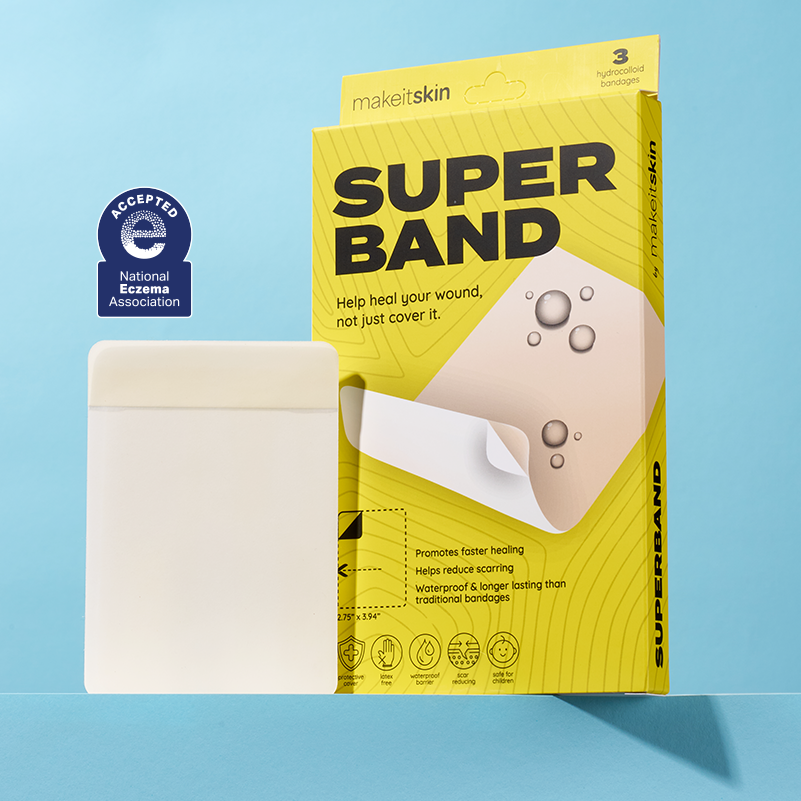
1. Hydrocolloid sheet: best for the open burn
A hydrocolloid dressing seals over the wound and absorbs light fluid into a soft gel, which is the whitish swelling you see under the sheet after a day or two. That seal holds moisture in and keeps a scab from forming.
The strongest data comes from a 28-day randomized controlled study published in PubMed Central. Wounds were randomized to a multi-day hydrocolloid bandage (BAND-AID Hydro Seal), a standard bandage replaced daily (BAND-AID Tru-Stay Sheer), or no covering. Median time to complete healing was 6.9 days with hydrocolloid, 11.9 days with the standard bandage and 11.8 days uncovered. At Day 28, the change in a composite scar score was 0.3 for hydrocolloid, 0.6 for the standard bandage and 2.1 for uncovered wounds, where a higher score means a worse scar.
The study used small laser-induced wounds on volunteers, so it models a minor burn rather than testing kitchen burns directly. It also tested Band-Aid's hydrocolloid, which makes it evidence for the format and says nothing specific about SUPERBAND.
A 2026 JAMA Dermatology trial by Bell and colleagues adds a useful counterweight. Among 146 patients after skin surgery, a hydrocolloid dressing left on for a week scored slightly better on scar appearance at seven days than daily petroleum ointment, but the difference was gone at 30 and 90 days (EMJ). Hydrocolloid users rated their dressing more comfortable and convenient, though they were also more likely to report bleeding or pain, likely from removing it too early (Healio). Syril Keena T. Que, MD, director of dermatologic surgery and cutaneous oncology at Indiana University School of Medicine, told Healio: "Hydrocolloid dressings are a reasonable alternative for patients who prefer to avoid daily wound care, with similar healing outcomes to traditional petroleum-based regimens."
That is why hydrocolloid ranks first on our criteria. Outcomes match or beat the alternatives, and you change it far less often, which matters when your hands are in water all evening.
Our pick in this format: SUPERBAND Cut-To-Size ($20 listed price). It is a flat hydrocolloid sheet you trim to the shape of the burn. Kitchen burns rarely land somewhere convenient: a fingertip that touched a pan, the back of a knuckle, a stripe on the forearm from an oven rack. Cutting your own shape lets the sheet cover the burn with a margin of healthy skin around it. We design SUPERBAND to be waterproof so it can stay on through handwashing and showers. If you trim sheets often, our Precision Carabiner Shears ($10) keep a clean edge. Follow the package directions for wear time, and replace the sheet if it leaks or the edges lift.
Hydrocolloid suits minor burns with light fluid. A burn that drains heavily, or one that looks infected, needs a clinician rather than a sealed patch.
2. Petroleum jelly under a bandage: the dermatologist method
This is the routine the AAD spells out: clean the wound, apply petroleum jelly, cover it with an adhesive bandage and change the bandage daily. The AAD adds that antibacterial ointment is unnecessary as long as the wound is cleaned daily, and that people whose skin reacts to adhesives can use a non-adhesive gauze pad held with paper tape.
The Bell trial above suggests scar outcomes land close to hydrocolloid over the long run. It ranks second on practicality. Daily changes and a slick layer of jelly are harder to keep in place on a hand that keeps getting washed.
For adhesive-sensitive skin, this can be the better choice. We cover that trade-off in our guide to choosing a gentle burn dressing for sensitive skin.
3. Plain adhesive strip without ointment
A dry strip keeps dirt off, and that has value. In the PubMed Central trial, though, a standard bandage changed daily healed in 11.9 days, essentially the same as leaving the wound uncovered at 11.8 days (PubMed Central).
The scar result is the more encouraging part. Covered wounds scored 0.6 on the scar scale versus 2.1 uncovered, so any cover beats none. Add a layer of petroleum jelly underneath and a plain strip effectively becomes option 2.
4. Silicone scar sheets: a later-stage tool
Products such as Neo G Opti-Heal Silicone Scar Strips and Rejuvaskin Scar Fx sheeting are scar treatments. UW Medicine describes silicone gel or sheets as something used on closed, healed skin, either to manage raised scars or to keep them from forming after healing, typically worn 12 to 24 hours a day for 2 to 4 months. Rejuvaskin's own guidance tells users to make sure the wound is completely closed before applying any silicone product (Rejuvaskin).
Within that later window the evidence is solid. An international advisory panel's scar algorithm recommends silicone-based products as the first-line option for preventing and treating excessive scarring after surgery or trauma (PubMed Central). The AAD also lists hydrogel or silicone gel sheets as possible options for burns and says to follow the package instructions for changing them.
Many small first-degree burns never need silicone. Consider it if the healed area turns raised, thick or persistently itchy, or if you know you scar easily. BAND-AID Brand's scar guide notes that keloids are most common in people with darker skin (BAND-AID Brand).
5. Dry gauze on its own
Ohio State Health & Discovery says the best burn bandaging is not something dry or gauze-like, which could stick to the wound, pull skin off and cause pain. A clinical review of burn dressings in MDPI's International Journal of Environmental Research and Public Health makes the same point: dressings that adhere tightly to a burned surface can cause new injury to fresh skin at every change and delay healing.
Gauze still has a place as a cushion over a moist layer, as in option 2. Used dry and directly on the burn, it combines a drying wound with painful removal.
A phase-by-phase plan for a kitchen burn
Right away. Hold the burn under cool water. BAND-AID Brand's guidance suggests five to 30 minutes, then patting the area dry with a clean, soft cloth (BAND-AID Brand).
Blisters. Leave an intact blister alone. UW Health notes that a blister can act as a natural protective barrier while a burn heals. If one pops or gets in the way of movement, ask a clinician how to handle it.
While the wound is open. Choose a multi-day hydrocolloid or daily petroleum jelly under a bandage, and keep the burn covered until new skin has closed over it. If you wash dishes every night, our dish-sink guide to waterproof burn bandages walks through keeping coverage intact.
After it closes. Protect the new skin from sun. The AAD recommends broad-spectrum SPF 30 or higher on a healed wound to help reduce red or brown discoloration. Move to silicone only if the area starts to rise or thicken.
For product-by-product picks within the hydrocolloid category, see our ranking of the best hydrocolloid bandages for minor burns at home.
SUPERBAND Cut-To-Size
20.00 USD
Shop now
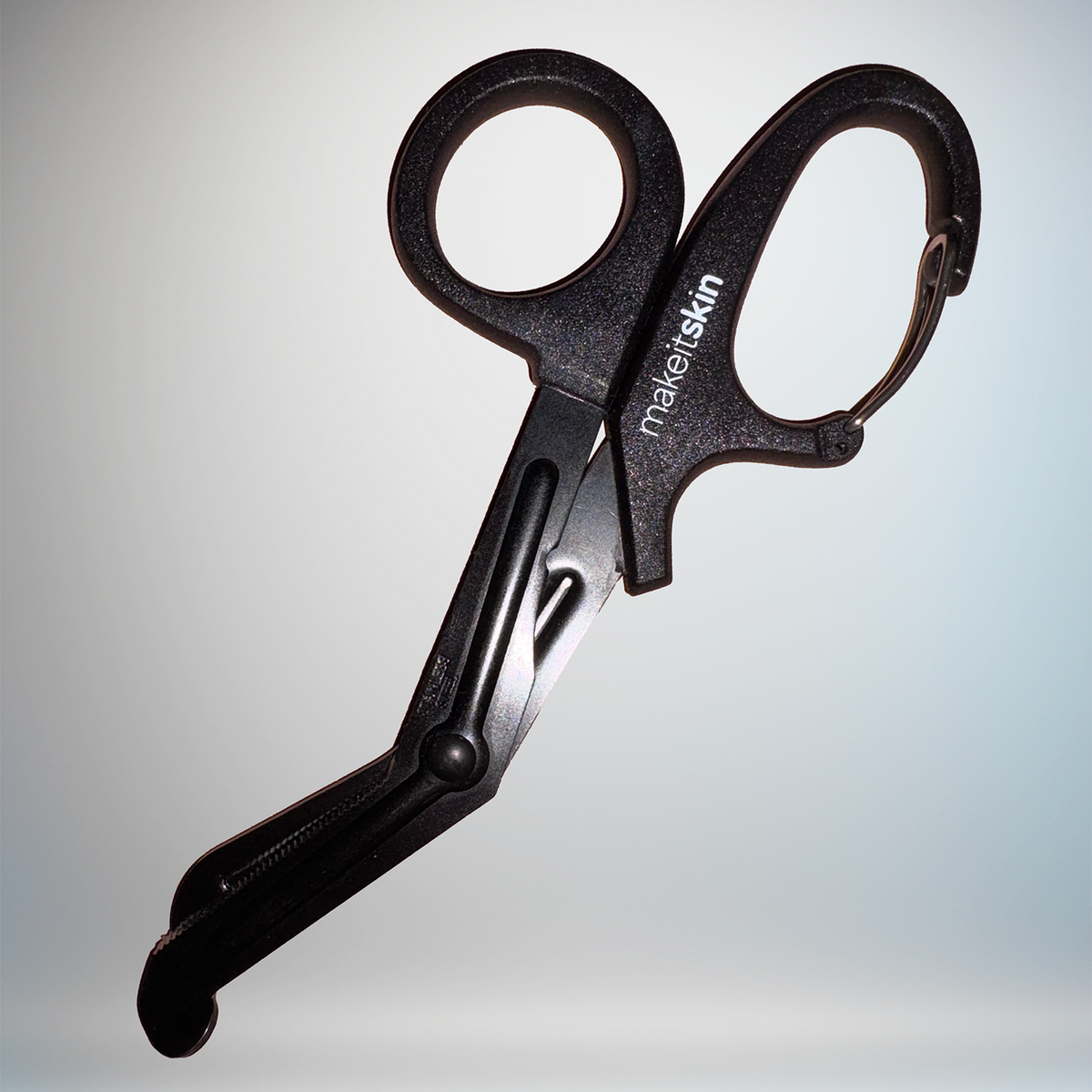
Precision Carabiner Shears
10.00 USD
Shop now
When a burn needs more than a bandage
The AAD advises immediate medical care if an injury is deep, very painful or becomes infected, and warns that a burn can turn serious without proper treatment. Ohio State Wexner Medical Center notes that third-degree burns need skin or synthetic grafts, while first- and second-degree burns usually heal without them. UW Health adds that a burn you have treated for more than a week without it healing should be seen by a doctor.
FAQ
Can I put a hydrocolloid bandage over antibiotic ointment?
Hydrocolloid sheets are meant to go on clean, dry skin, and ointment underneath can interfere with how well the adhesive grips. The AAD says antibacterial ointment is not necessary as long as the wound is cleaned daily. Follow your bandage's package directions, and choose either the hydrocolloid route or the ointment-plus-bandage route rather than layering them.
Is the white bubble under a hydrocolloid a sign of infection?
The whitish, puffy area is the hydrocolloid absorbing wound fluid, and it is expected. Worsening pain, spreading redness or pus are reasons to remove the dressing and see a clinician.
Is it too late to prevent a scar if the burn already scabbed?
Covering still helps. Keep the area clean and moist from that point, and avoid picking the scab: BAND-AID Brand notes that picking a scab can cause inflammation (BAND-AID Brand). Once the skin has fully closed, sun protection and, if the scar rises, silicone sheeting are the tools for the next stage.
Can I use a silicone scar sheet as the first dressing on a fresh burn?
No. Silicone scar sheets are designed for closed skin, and guidance from UW Medicine and Rejuvaskin places them after the wound has closed. Use a moist wound dressing first.
Keeping a sheet of SUPERBAND Cut-To-Size in the kitchen drawer means a moist, trimmable dressing is ready the moment a pan handle catches you. You can find it in the product cards above, alongside our shears.


