

Best Bug Bite Relief Patches 2026: Patch vs Cream
A mosquito bite itches because of an immune reaction to the insect's saliva. Scratching can break the skin and increase the risk of infection or lasting marks. Inflammation from the bite itself may also leave discoloration. A hydrocolloid patch covers the bite, which may help reduce scratching by keeping it out of reach; an anti-itch cream calms the itch sensation on intact skin. They solve different problems and are not required to be used together.
Cleveland Clinic advises against scratching, and says that if you do break the skin, wash it with soap and water and cover it. A patient guide from MultiCare makes the same point and adds that repeated scratching can lead to longer-term marks.
We make one of the products below, so here is the honest frame: our criteria are stated first, every option is described against those criteria, and the limits of our own patch are listed alongside everyone else's. Nothing here is a clinical comparison — we have not run a head-to-head trial against these competitors.
What we're comparing
- Barrier quality. Does it stay sealed through sleep, a shower, a pool?
- Usable on a bite that's already been scratched open? Per its own labeling — not assumed.
- Mechanism you can explain. Absorption and occlusion are physical and observable. Claims about draining unnamed "itch substances" are harder to verify.
- Stated skin guidance. What the brand's own label says about kids, sensitive skin, and drug content — not a blanket medical claim we're making on their behalf.
- Fit. Bites cluster on ankles, knuckles and hairlines; shape options matter.
- US availability. Amazon, CVS, Target, Walmart or direct.
How inflammation and scratching can leave marks
A mosquito injects saliva to keep blood flowing while it feeds. The immune system reads those proteins as foreign and releases histamine, producing the welt and the itch as a mild allergic reaction (MultiCare).
Scratching relieves the itch briefly and makes the area more inflamed and itchier, which is the loop that keeps bites going. Once a scratch breaks the skin surface, the bite becomes an open wound, which raises the risk of a lasting mark or scar. Inflammation from the bite itself can also leave temporary post-inflammatory pigmentation even without scratching; scratching makes a mark more likely, not the only way one can occur.
What the evidence supports, and what it does not
Hydrocolloid is a gel-forming dressing material. It absorbs wound fluid and helps maintain a moist covered environment. Whether a specific patch is suitable for broken skin depends on its label. The barrier effect is mechanical: a sealed patch may help reduce scratching by covering the area. We haven't run a controlled test measuring how completely it blocks contact, and no hydrocolloid patch is a guaranteed barrier against all bacteria. We wrote up the underlying healing science in more detail in The Science Behind Moist Wound Healing.
Centella asiatica is the other ingredient worth understanding on its own terms. A 2022 systematic review published in the International Journal of Environmental Research and Public Health and indexed on PubMed found four clinical trials meeting its inclusion criteria and concluded that C. asiatica might enhance wound healing through improved angiogenesis and collagen production, while explicitly calling for more research. A 2024 review of topical use, also indexed on PubMed, traces the effect to compounds including asiaticoside and madecassoside.
Read that carefully before drawing conclusions: those trials studied gels and extracts on surgical, burn and post-laser wounds. None tested a patch on a mosquito bite. Centella has a credible skin-repair rationale from wound research generally — that research does not demonstrate that any specific bug-bite patch treats bites or heals them faster than an alternative.
The options
SUPERBAND Bug Bite Relief ($16) — our product
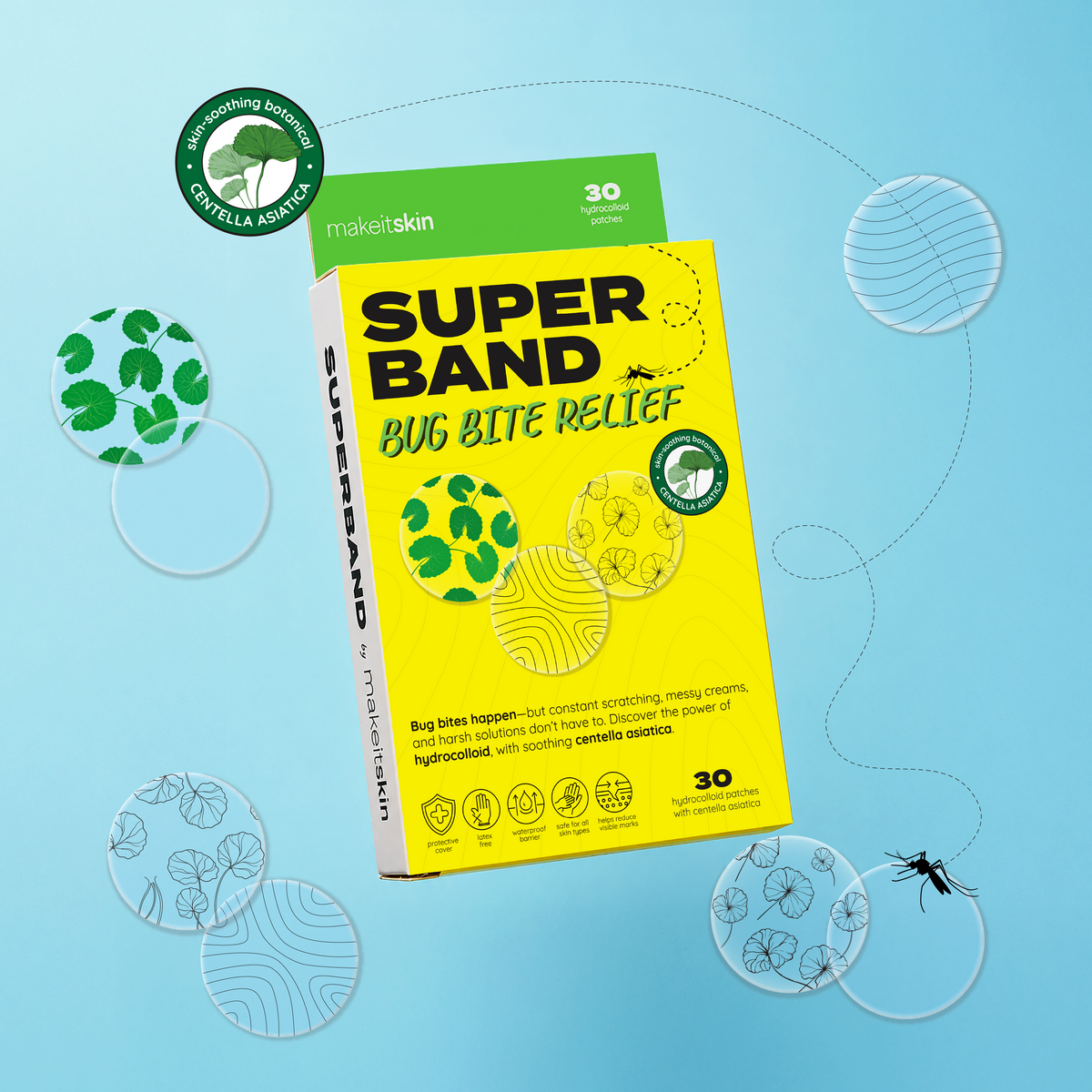
A hydrocolloid patch infused with centella asiatica. Per our product page, it is waterproof, latex-free, drug-free, and labeled for external use only, with instructions not to use on deep or infected wounds and to discontinue use if irritation, rash, or worsening occurs.
The hydrocolloid body absorbs fluid from an already-scratched bite rather than requiring removal, and it is designed to stay sealed through showers and sleep. There is no added drug, so there's no topical steroid to track across multiple bites. Centella is included for its repair-phase rationale — as the evidence section above notes, the supporting research is on other wound types, not bite-specific trials, and we're not claiming our patch heals faster than any competitor's.
Limits, stated plainly: we have no published clinical trial on this specific patch. If a fresh, unbroken bite is at peak itch, the AAD suggests an ice pack or an over-the-counter anti-itch cream for the sensation itself — we don't have head-to-head data comparing our patch's effect on itch to that.
SUPERBAND Bug Bite Relief
16.00 USD
Shop now
Welly Bug Bite Relief Patches
Welly's product page describes a drug-free hydrocolloid patch in kid-friendly shapes, water-resistant, packed in a reusable tin, stated to be wearable for up to 10 hours (Welly). That listing does not itself state whether the patch is intended for already-broken skin — check the package before using it on a scratched bite. The kid-oriented shapes are a real compliance advantage: a patch a child is willing to wear is one that stays on. Widely stocked at Target and Amazon.
Cutter Bug Bite Itch Relief Hydrocolloid Patches
Cutter's listing describes dermatologist-tested hydrocolloid patches that absorb fluid from the bite and create a barrier, sold in a 51-count pack, marketed as a hydrocortisone/suction-tool alternative (Cutter). It's a bug-aisle name, stocked next to repellents at Walmart and grocery chains. Fragrance-free, drug-free. As with Welly, confirm on the package whether it's meant for skin that's already broken before applying it to one.
NATPAT MagicPatch
MagicPatch is NATPAT's itch-relief patch for an existing bite. Per NATPAT's own product page, it uses a mechanical grid design, is chemical-free, and is designed to be worn directly on skin. Check NATPAT's page for its specific wear-time and open-skin guidance before use.
Moskinto Original Itch-Relief Patch
Moskinto uses a grid-shaped design the company says lifts the outer layer of skin to help draw out substances left by the bite. Its own product page states the patch is drug-free and waterproof, lasts roughly 4 to 7 days, and — notably — states directly that the effect has not been scientifically proven, basing its claims on experience and case studies rather than trial data (Moskinto). Moskinto's own guidance is that the patch should not be applied to open wounds, so once a bite has been scratched open, this specific patch is not the label-supported choice — worth noting since that's exactly when a barrier matters most. Stocked at Walmart, CVS and Amazon.
Patch vs anti-itch cream
| Hydrocolloid patch | Anti-itch cream (hydrocortisone 1%) | |
|---|---|---|
| What it targets | Covers the site and may help reduce scratching | The itch sensation itself |
| Mechanism | Physical barrier, absorbs fluid | Topical steroid, pharmacological |
| Use on skin already broken | Check the specific product's label | Check the label; not all creams are meant for broken skin |
| Active drug | Drug-free (hydrocolloid) | Topical steroid |
| Best suited to | A bite you've already scratched, or want to stop scratching | An intense itch on skin that's still intact |
The AAD advises that for bites that itch, you can apply an ice pack or an over-the-counter anti-itch cream such as hydrocortisone. That guidance addresses the itch sensation; it doesn't address the fingernail-access problem a barrier product is built for. These are two different jobs. Don't apply a patch over a medicated cream unless the product's own directions or a clinician says it's fine — combining an occlusive patch with a topical steroid changes how the medication is absorbed, and drying the area first does not remove that effect. Treat patch and cream as separate options rather than a stacked routine unless you've checked with a pharmacist or clinician.
How to use a hydrocolloid bug bite patch
- Wash the bite with soap and water if it has already been scratched.
- Dry completely. Damp or oily skin is a common reason a patch lifts early.
- Choose a patch wider than the welt so the adhesive border sits on intact skin.
- Press firmly for several seconds so body heat helps the adhesive seat.
- Leave it in place until the specific product's label says to change it — this varies by brand (Welly states up to 10 hours; Moskinto states 4–7 days; our own label says to leave it until it lifts, turns white, or needs replacing). A whitish gel may form from absorbed fluid, but its appearance alone cannot rule out infection. Stop and seek clinical advice for spreading redness, warmth, increasing pain or pus.
- Remove slowly, stretching the patch parallel to the skin rather than pulling it upward.
Always check the specific product's own package directions — hydrocolloid products differ in wear time and open-wound guidance, and this list is not a substitute for reading the label in front of you.
Bites on kids
Children often scratch bites reflexively, including during sleep, which is part of why an itch that seems minor during the day can turn into a broken-skin wound overnight (MultiCare).
A few practical things make a patch easier to use with a child: a design they're willing to wear (which is why kid-shaped brands exist), a drug-free formula so a topical steroid isn't being applied across multiple bites for days, and durability through bath time. None of this is a claim that any drug-free or hydrocolloid product is automatically safe for every child or every skin condition — supervise application for toddlers, keep small patches away from anyone who still mouths objects, and check with a pediatrician if your child reacts to bites with large welts or if they have eczema or another skin condition, since individual tolerance varies.
When to stop patching and call a clinician
Cover a bite, and check it. Cleveland Clinic advises seeing a healthcare provider for a bite that appears infected, and for symptoms including allergic reaction, fever, headache or body aches after a bite. Spreading redness, warmth, pus, swelling around the eyes, or a bite getting worse rather than better all belong with a clinician instead of another patch.
Bug bite patches manage minor, everyday bites. Nothing in this article treats an allergic reaction or an infection.
FAQ
Do bug bite patches actually stop the itch?
Indirectly, and it isn't clinically measured. A hydrocolloid patch covers the area, absorbs fluid, and keeps skin from drying out, which some people find reduces the itch somewhat simply by changing the sensation at the site — but there's no trial data showing it relieves itch faster than a cream. The patch may help by covering the area, which can make scratching harder and help break the cycle, though we haven't tested how completely it prevents contact. The AAD's suggestion for the itch sensation itself, on intact skin, is an ice pack or hydrocortisone — we don't have data comparing its speed to a patch's effect on itch.
Can kids use bug bite patches?
Several brands sell drug-free hydrocolloid patches in kid-focused shapes specifically because they're marketed as suitable for children, but check the specific product's own label rather than assuming any hydrocolloid patch is appropriate for every child. Supervise application for small children, avoid small patches with anyone who might mouth them, and check with a pediatrician for eczema-prone skin or unusually large or persistent reactions — individual tolerance varies and "drug-free" is not the same as "guaranteed safe for this skin."
How long should I leave a patch on?
It depends on the product — check the label. Stated wear times vary by construction: Welly states up to 10 hours for its patch, Moskinto states 4 to 7 days for its grid design. A patch that's stopped absorbing (fully saturated or lifting at the edge) should be replaced regardless of the stated window.
Will a patch stop a bite from scarring?
No product here can promise that, and we're not claiming ours does. A patch may help reduce scratching by covering the site, but it cannot guarantee that scratching or a mark will be prevented. If you already have a dark mark from an old bite, that's typically post-inflammatory pigmentation, and a dermatologist is the right call for treating it.
Patch or cream for a big, swollen bite?
A large, swollen welt is an inflammatory reaction; ice or an over-the-counter hydrocortisone cream (per the AAD) addresses swelling and itch on intact skin. A patch is suited to skin that's already broken or that you want to protect from scratching. Don't combine a medicated cream with an occlusive patch unless the product's label or a clinician says it's fine — treat them as separate options rather than a stacked routine. If swelling is dramatic, spreading, or comes with fever, that's a clinician's call, not a product choice.
If a bite has already been scratched open, a hydrocolloid patch is one option for covering and protecting it while it heals. Ours pairs the patch with centella asiatica: SUPERBAND Bug Bite Relief, $16.


