
Best Cut-to-Size Hydrocolloid for Awkward Wound Spots
For awkward spots like fingertips, knuckles, toes, heels, elbows, knees and palms, the cut shape decides whether a cut-to-size hydrocolloid bandage stays sealed. Size the piece with at least a 5 mm margin, round every corner and apply it to fully dry skin. A 2-inch roll (Dimora, Ovena) suits long, narrow wounds, while a flat sheet such as SUPERBAND Cut-To-Size lets you cut in both directions for wide or irregular scrapes.
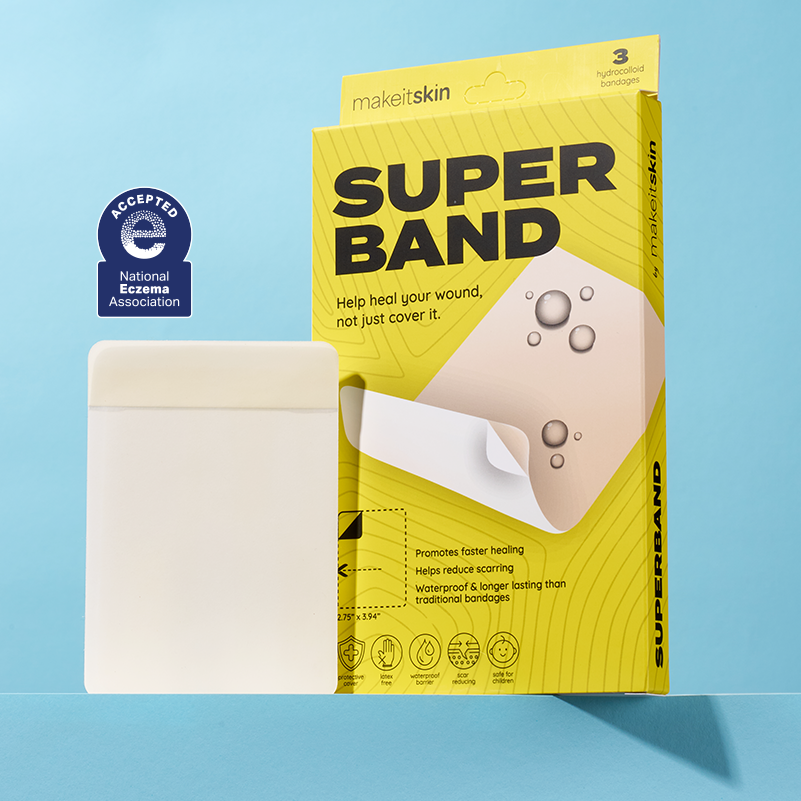
We make SUPERBAND Cut-To-Size, a flat hydrocolloid sheet, so we spend a lot of time with scissors and oddly placed scrapes. This guide ranks six awkward spots from the smallest, fastest-moving areas to the widest ones, gives the shape we cut for each, and compares flat sheets with the rolls most people search for. It covers minor, clean, shallow wounds only.
How a hydrocolloid seal holds at awkward spots
A hydrocolloid dressing holds gel-forming particles under a water-resistant film. When those particles meet wound fluid they swell into a soft gel that keeps the surface moist, as Ovena Health explains in its roll guide. That moisture matters: the American Academy of Dermatology notes that wounds allowed to dry into scabs take longer to heal.
The seal only works if the edges stay down. Three technique points from the same Ovena guide do most of the work at awkward spots:
- Margin: cut so the piece extends about 5 mm (a quarter inch) past the wound on every side, and cut larger when unsure.
- Rounded corners: square corners are the first part to peel, especially on a joint, heel or elbow that flexes.
- Warm it first: holding the cut piece between your palms for 15-30 seconds softens the adhesive so it follows skin contours instead of bridging over them.
Sources disagree slightly on margin. Ovena's minimum is about 5 mm, while our own hydrocolloid guide suggests 1-2 cm of overlap where the spot allows it. On a fingertip you may only fit the minimum. On a knee, use the wider margin.
The ranked guide: six awkward spots and the cut for each
We ordered these by how small and mobile the area is, because the smaller the area and the more it bends, the less room the adhesive has to hold. The shapes below are the ones we use at home. They are practical geometry, and your wound's outline always wins over a template.
1. Fingertip
Fingertips combine a tiny surface, constant contact and a rounded end. We cut a rectangle about twice as long as it is wide, then snip a small V into the center of each short end. Fold the piece over the tip lengthwise so the notches let the corners overlap without bunching. Round all four outer corners. Warming the piece in your palms before application helps most here.
2. Knuckle
A knuckle stretches the skin every time you make a fist. We cut a rectangle and make a short slit into the middle of each long side, which leaves an "H" shape. The center of the H sits over the wound, and the four tabs wrap above and below the joint. Apply with the finger slightly bent so the piece does not tug when you curl your hand. Dimora Medical's selection guide points in the same direction for joints: flexible pieces with tapered edges hold better there.
3. Between the toes
This spot is narrow, damp and rubbed by the neighboring toe. Cut a slim strip with fully rounded ends, closer to a capsule than a rectangle. Dry the skin completely before application. Ovena notes that leftover moisture is the most common reason a new dressing peels within hours, and between the toes is where moisture hides.
4. Heel
The heel takes friction from shoes and pressure from every step. We cut a wide oval that wraps slightly up the back of the heel, giving the edge somewhere to anchor away from the rubbing point. If a small blister has formed, leave it intact: the AAD's advice for burn blisters is to let them heal on their own under a covering, and we apply the same caution to friction blisters. Runners heading out the door may prefer a pre-cut option, which we cover in our marathon blister guide.
5. Elbow or knee
These joints bend through a wide range and often collect broad, irregular scrapes from falls. Cut a large oval or rounded rectangle that covers the whole scrape plus the wider 1-2 cm margin, and apply with the joint bent about halfway so the piece is not stretched tight when you move. Be realistic about outcomes: the AAD notes that scars over joints like knees and elbows are hard to avoid, even with good home care.
6. Palm or forearm
These areas are flatter but produce the widest, most irregular scrapes, such as a hand that caught a fall on pavement. Trace the scrape's outline loosely, add the margin and follow the shape with gentle curves. Here the width of your starting material decides whether one piece is enough.
Flat sheet or roll: which format fits the job?
A roll gives you a continuous strip at a fixed width. The Dimora roll measures 2 inches by 16 feet, and Ovena sells 2-inch rolls in 5-foot and 16-foot lengths, according to its DuoDERM comparison page. With that much length on hand, a roll handles long, narrow wounds well. Width is capped at 2 inches, so a wide palm or knee scrape means overlapping strips.
A flat sheet lets you cut in both directions from one piece, which suits wide or multi-directional shapes. Before buying any sheet, compare its listed dimensions with the areas you most often need to cover.
Pre-cut hydrocolloid sheets are a third route. Ovena's comparison page reports that DuoDERM Extra Thin comes in eight pre-cut shapes and sizes, from a small spot size up to a 6 x 7 inch triangle.
| Format | Example | Strengths | Trade-offs | Best fit |
|---|---|---|---|---|
| Flat cut-to-size sheet | SUPERBAND Cut-To-Size, $20 | Cut in both directions; one piece for irregular outlines | Check the sheet size against your largest likely wound | Palm, elbow, knee, odd shapes at home |
| 2-inch roll | Dimora (2 in x 16 ft), Ovena (2 in rolls) | Long strips; lots of material per package | Width capped at 2 inches | Fingertips, toes, long thin scrapes |
| Pre-cut shaped sheets | DuoDERM Extra Thin | No cutting; set shapes | Fixed sizes may not match your wound | When a stock shape happens to fit |
Our picks by job, using fit for irregular outlines as the first criterion and material per package as the second:
- Wide or irregular scrapes at home: a flat sheet. Ours is SUPERBAND Cut-To-Size.
- Long, narrow wounds or high-volume use: a 2-inch roll such as Dimora or Ovena.
- No scissors available: a pre-cut shaped dressing sized to the wound.
Clean edges start with the scissors
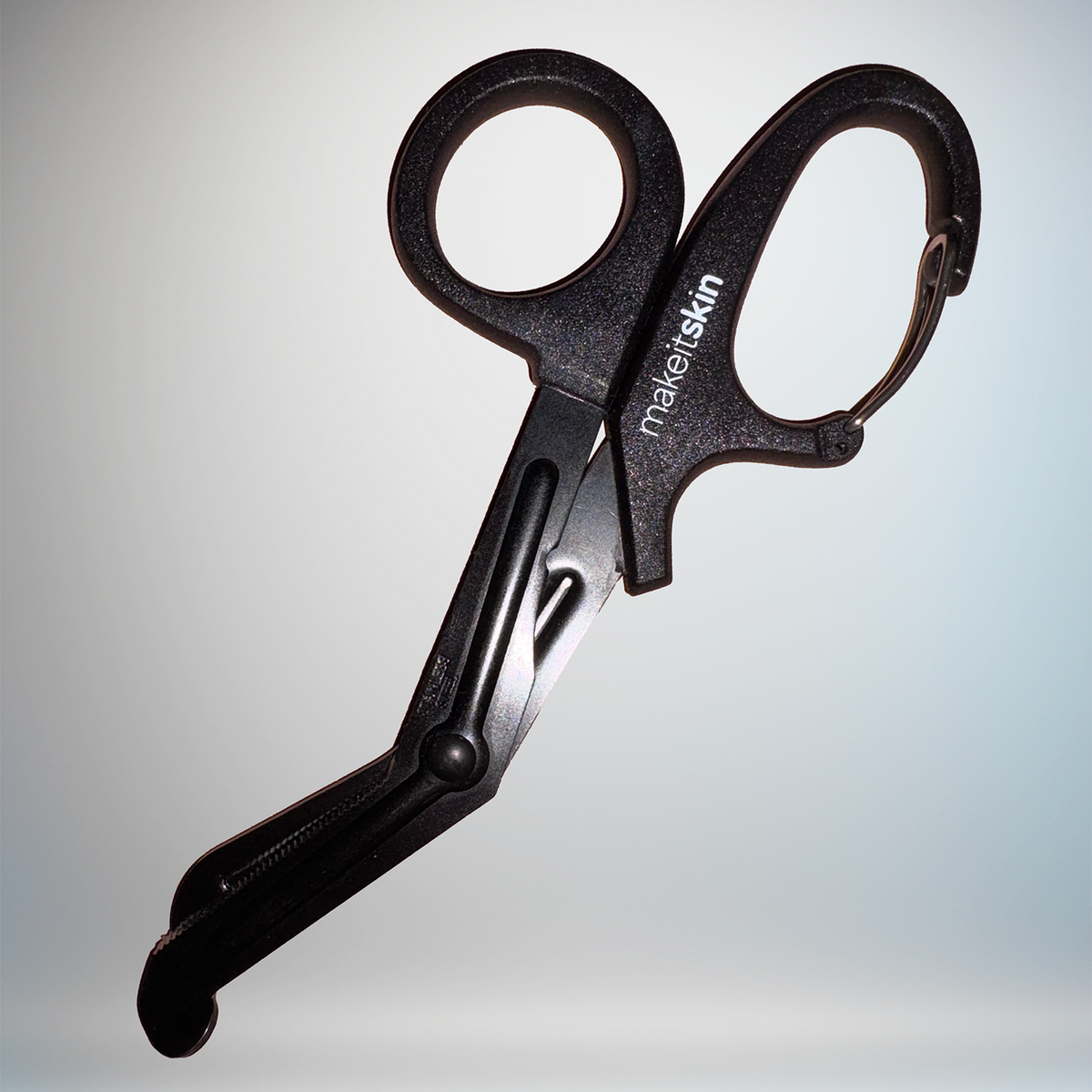
Ragged or fraying edges give the adhesive an easy starting point to lift. Sharp scissors reserved for dressings make the rounded corners above much easier to cut in one smooth pass. We keep our Precision Carabiner Shears ($10) clipped to a bag with the sheet so both travel together. Any clean, sharp pair works, and wiping the blades before cutting keeps the process hygienic.
SUPERBAND Cut-To-Size
20.00 USD
Shop now
Precision Carabiner Shears
10.00 USD
Shop now
When to change it, and when hydrocolloid is the wrong choice
A white or pale yellow bubble under the dressing is gel from absorbed fluid. Ovena's roll guide advises changing the piece when that bubble reaches within about 5 mm of the edge or when it starts to leak, and its DuoDERM comparison makes the same point: change it when the gel front reaches the edge or the seal breaks, rather than on a fixed schedule. On a fast-moving spot like a knuckle, expect to change it sooner.
Skip hydrocolloid in these situations, per Dimora Medical:
- Signs of infection: redness, heat, throbbing or foul-smelling pus. The airtight seal can trap bacteria.
- Deep puncture wounds.
- Heavy bleeding or weeping: Dimora suggests foam dressings for heavily draining wounds.
Clean the area first with water. The AAD's minor-cut guidance also recommends checking that your tetanus vaccination is current if the cut came from a dirty or rusty object.
FAQ
Can I put petroleum jelly under a hydrocolloid bandage?
We don't recommend it. The AAD suggests petroleum jelly under a regular sterile bandage to keep a cut moist, while hydrocolloid creates that moisture itself and needs dry skin to stick. The Dimora roll listing asks users to avoid lotions or oily products before application. Pick one approach per wound.
When is a cut too big for home care?
In an AAD news release, the academy says most minor cuts heal within a week, and it advises immediate medical attention for a cut longer than three-quarters of an inch, deeper than a quarter inch, or one that won't stop bleeding.
Can I use a hydrocolloid on a scar that has already healed?
Dimora's roll listing says its hydrocolloid is not for scar care and advises against using it on healed or raised scars, suggesting silicone sheets or gel instead. Hydrocolloid is meant for the open, healing stage.
Will a cut piece stay on in the shower?
Ovena describes hydrocolloid as water-resistant and says a short shower is generally fine when the edges are firmly pressed down, while long soaks can loosen them (Ovena Health). We compared options in which bandage actually stays on in the shower.
Start with the right sheet
If your scrapes tend to land on palms, knees and other places a stock bandage won't fit, keep a flat sheet and a sharp pair of scissors together. SUPERBAND Cut-To-Size is our version, and our guide to choosing hydrocolloid bandages covers the rest of the category.


