

Gentle Burn Dressing for Sensitive Skin: How to Choose
For a minor household burn on sensitive or eczema-prone skin, the safest cover is a thin, nonstick, moisture-retaining dressing sized so its adhesive border sits on as little healthy skin as possible. Adhesive reactions start on the intact skin under the border, not on the burn itself, so a sheet you trim to the burn beats a pre-cut pad you have to work around. Cool the burn under running water for about 10 minutes first, skip ointments and topical antibiotics, and leave blisters intact.
We make SUPERBAND, a hydrocolloid dressing sold as flat cut-to-size sheets and pre-cut On-The-Go pieces, so we spend a lot of time reading complaints about bandages that itch, lift, or leave a red rectangle behind. The pattern in those complaints is consistent: the burn is the small part of the problem. The wide adhesive frame pressed onto healthy skin for two or three days is where the redness usually shows up.
That distinction matters for anyone with reactive skin, because it changes what you shop for. Formula gets all the marketing attention. Fit is the variable you can actually control at the kitchen counter.
What the burn under the dressing needs
Covered burns heal in a moist environment, and the clinical literature is unusually consistent about why that helps. A review in Advances in Wound Care, published via PMC, reports that wet or moist treatment promotes re-epithelialization and results in reduced scar formation compared with treatment in a dry environment, and that the inflammatory reaction is reduced in the wet environment, which limits injury progression.
The size of that difference has been measured in burn patients. A retrospective cohort of 173 people recovering from split-thickness skin graft surgery, published in Clinical, Cosmetic and Investigational Dermatology by Dove Medical Press, found a mean healing time of 13.23 days with a moist wound healing strategy against 16.85 days with traditional dry care, and lower reported pain scores from day 4 onward.
Read that evidence for what it is. It comes from surgical donor sites managed by clinicians, and it tests moist healing as a category rather than any single consumer product. What it establishes is the principle: a burn that stays hydrated and covered closes faster and hurts less than one left to dry and scab.
Where the irritation actually comes from
Two different things get called an adhesive reaction, and they are worth separating.
Allergic contact dermatitis is an immune response to a specific chemical. Wyndly lists the usual culprits as acrylates, rosin (colophony) and rubber accelerators, with symptoms appearing at the contact site as redness, itching, swelling and blistering, and notes that people with a history of allergic contact dermatitis or allergic eczema may be more prone to developing them.
Irritant contact dermatitis is mechanical and chemical wear on the skin barrier, and it is more common than most people assume. When Widman, Oostman and Storrs patch-tested patients who reported reacting to medical bandages, published in Dermatitis in 2008 and indexed on PubMed, they found no relevant allergic reactions to the tapes or bandages themselves. Eight of the eleven patients who wore a bandage for seven days developed an irritant reaction, and the authors concluded the perceived reactions were irritant rather than allergic.
That study is small, and it should not be read as proof that adhesive allergy is rare in general. It does support something practical: a large share of "my skin reacts to bandages" is driven by how much skin is under adhesive, and for how long, rather than by a specific allergen you need to identify.
Both mechanisms point the same direction for sensitive skin. Less adhesive on intact skin, and fewer removal cycles, means less to react to.
The overhang problem
Pre-cut dressings come in a handful of shapes. Burns arrive in none of them. A splash from a pan lands as an irregular streak along a finger, an oven rack catches the inside of a forearm, hot oil leaves a scatter of small marks.
Cover one of those with a pad built for a fingertip and you get overhang: adhesive lying on healthy skin well beyond the injury, often across a knuckle or a crease where it will crumple and start lifting. Every millimetre of that border is skin that has to tolerate the adhesive for the full wear time. Lifting edges then invite an early change, and each change is another peel on skin that is already annoyed.
Trimming a flat sheet to the burn removes that surplus. You keep the border you need for a seal and give away nothing else.
What hydrocolloid does on reactive skin
Hydrocolloid is the material behind acne patches and blister patches: a gel-forming layer on a thin, flexible, waterproof backing. It absorbs wound fluid, turns opaque white as it does, and lifts away as gel rather than dry adhesive stuck to new skin.
There is direct dermatology evidence for its use on badly irritated skin. In a case series of three young children with recalcitrant facial atopic eczema, published in the Australasian Journal of Dermatology and indexed on PubMed, dermatologist Marius Rademaker used masks fashioned from an adhesive hydrocolloid dressing. Symptomatic control of itch or soreness came within hours, the eczema was markedly improved by seven days, and each mask lasted one to four days. Speaking to Healio about the series, Rademaker said "By using a hydrocolloid dressing over several days, one can minimize the effects of rubbing."
Three children is a case series, and facial eczema differs from a kitchen burn in both cause and depth. Take the transferable part: a hydrocolloid layer sits on inflamed, eroded skin for days at a time, blocks scratching and rubbing, and comes off without a fight. Those are the same properties you want on a burn that is going to get bumped by a sleeve for the next three days.
How we build for fit
SUPERBAND Cut-To-Size is a flat hydrocolloid sheet you trim with scissors, currently $20. You cut the shape the burn needs, which is the point of the format: a narrow strip for a splash along a finger, a wide rectangle for a forearm, a rounded piece for a knuckle so it flexes without peeling. The Starter Kit at $25 pairs sheets with our Precision Carabiner Shears, because cutting a clean edge matters more than people expect. Ragged edges catch on cuffs and start the lift.
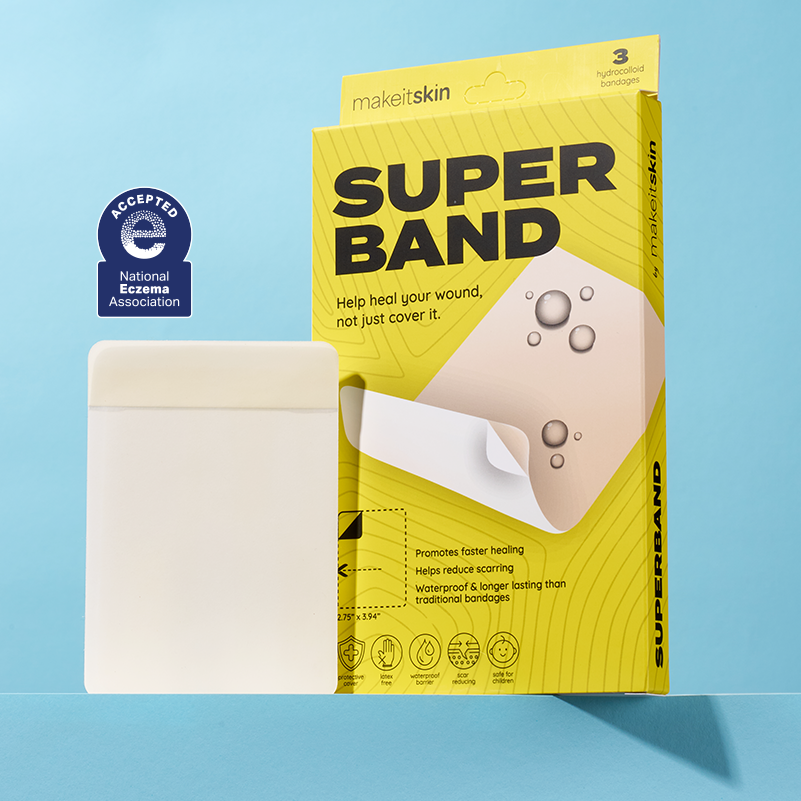
SUPERBAND On-The-Go at $15 is the pre-cut version, and it exists for the bag rather than the kitchen. When the burn is small and regular and you are not near scissors, a pre-cut piece is the sensible pick.
We are careful about how far we take the sensitive-skin claim. Our dressings are designed for low irritation and use no latex, and none of that guarantees your skin will tolerate them, because individual tolerance varies and no dressing is exempt from that. If you have reacted to adhesives before, wear a small trimmed piece on intact forearm skin for a day before putting one on a burn, and read the package directions.
Applying one to a fresh kitchen burn
The dressing is the last step, and the steps before it are not ours to invent. The American Academy of Dermatology recommends immediately immersing a first-degree burn in cool tap water or applying cold wet compresses for about 10 minutes or until the pain subsides, then covering the burn with a nonstick sterile bandage. The AAD also advises against applying ointments, toothpaste or butter, which may cause an infection, and against topical antibiotics. If blisters form, let them heal while keeping the area covered, and do not pop them.
Working from that, our sequence is:
- Cool first, for the full ten minutes. Cool running water, never ice. The dressing goes on once cooling is finished.
- Dry the surrounding skin properly. Adhesive fails on damp skin, and a failed seal is the most common reason a dressing gets changed early.
- Cut to the burn. Trace roughly the shape of the injury and add a small even border, a few millimetres, all the way around. Round the corners.
- Warm it in place. Press with a clean palm for about half a minute so the adhesive settles against skin temperature.
- Leave it alone. Change when the white gel patch reaches the edge of the dressing or the seal breaks, not on a schedule. Fewer peels, less irritation.
A cut piece on a finger that has to bend all day is the one situation worth a second thought. Cut it slightly longer than the burn and orient the long axis along the finger rather than around it, so bending stretches the sheet instead of shearing the seal.
When to stop and get help
Home dressings have a boundary, and burns are the category where people push past it. Mayo Clinic advises emergency care for burns that go through all layers of skin, that make the skin look dry, leathery or charred, that are larger than about 3 inches across, or that affect the face, hands, feet, genitals, buttocks or major joints. Chemical and electrical burns belong in the same bucket.
Watch a healing burn for spreading redness, increasing pain after the first couple of days, pus or fever, and get it looked at if any of those appear. A dressing that keeps a wound moist should never be used to wait out a wound that is getting worse.
If you want the wider comparison of dressing formats, we walked through it in our guide to choosing a hydrocolloid bandage, and the adhesive-tolerance discussion goes deeper in our piece on low-irritation patches for sensitive skin.
FAQ
Can I put a hydrocolloid dressing on a burn blister that has not broken?
Cover it and leave it intact. The AAD's guidance for minor burns is to let blisters heal on their own while keeping the area covered and not to pop them. A thin hydrocolloid sheet cushions the blister from knocks while it does that. If the blister is large, on a joint, or on the face or hands, have it seen rather than dressed at home.
Does the white bulge under the dressing mean it is infected?
That whitening is the hydrocolloid absorbing wound fluid and forming gel, which is how the material works. Infection presents differently: spreading redness beyond the dressing, worsening pain, pus, or fever. Those signs warrant a clinician, not a new patch.
Should I put ointment under the dressing?
Not on your own initiative. The AAD advises against applying ointments to a minor burn and against topical antibiotics, and ointment under an occlusive dressing also ruins the adhesive seal. Follow whatever a clinician tells you for a specific wound.
How do I know whether my skin reacted to the adhesive or to something else?
Adhesive reactions show up where the adhesive sat, typically as a border-shaped patch of redness and itch on skin that was never burned. That shape is the tell. Irritant reactions build with wear time, which is why trimming away surplus adhesive and extending wear between changes helps. Persistent or worsening reactions are worth a dermatologist's patch testing rather than guesswork.
Is a cut-to-size sheet worth it if I only have the occasional burn?
If your skin tolerates standard bandages easily, pre-cut pieces are fine and faster. Trimming pays off when the burn is an awkward shape, when it sits on a knuckle or crease, or when your skin has objected to adhesive borders before.
Ready to keep one in the kitchen drawer? The SUPERBAND Cut-To-Size sheets trim to whatever the stove hands you, and the Starter Kit adds the shears that make the cut clean.


