
Low-Irritation Blister Patches for Sensitive Skin
For athletes whose skin reacts to bandages, the best blister cover is the one that goes on once and stays on. Hydrocolloid patches seal against friction and sweat and hold through showers and training, which cuts the number of times adhesive has to be peeled off already-irritated skin. Cut the patch well past the edge of the sore spot, press it warm, and change it only when the gel pad reaches the border or the seal lifts.
Most advice for reactive skin stops at "use a gentle bandage." That misses what actually inflames the skin during training: the repeated cycle of sticking and stripping, twice a day, on a heel that is also being rubbed by a shoe. We build SUPERBAND for people in exactly that loop, so this guide is about the mechanics of adhesive irritation and how to work around them.
Where the redness usually comes from
Clinicians have a name for the ring of angry skin left behind by a dressing. Medical adhesive-related skin injury (MARSI) is defined by WoundSource as erythema or other skin trauma that persists longer than 30 minutes after the adhesive comes off. The same reference describes the mechanism plainly: damage happens when the bond between skin and adhesive is stronger than the bond between skin cells, so the epidermal layers separate when you pull.
That is mechanical, and it happens to everyone. Two other categories sit alongside it. Irritant contact dermatitis comes from the chemistry and the friction of the product itself. Allergic contact dermatitis is an immune response to a specific ingredient in the adhesive or the backing.
A 2024 review in the Journal of Tissue Viability notes that most medical adhesives are built from acrylate, hydrocolloid or silicone chemistry, and that all three material families are associated with MARSI. The review also points out why this matters beyond comfort: these injuries reduce skin integrity, cause pain, delay healing and raise infection risk.
"Hypoallergenic" on a box tells you a manufacturer avoided the common allergens. It says nothing about how hard the adhesive pulls on removal. If your skin reacts to one product, work out whether the reaction is to the chemistry or to the peeling, because the two have different fixes.
Sweat, occlusion and why the barrier is already compromised
Researchers writing in ACS Applied Bio Materials measured adhesive irritancy through trans-epidermal water loss, protein stripping, erythema and ease of removal, and described how repeated application and removal of adhesive films lifts corneocytes off the stratum corneum. Their write-up also flags moisture-related damage from prolonged exposure to sweat and wound fluid, and maceration when a dressing traps water against skin that cannot breathe.
Athletes hit both problems at once. You sweat under the patch for two hours, then peel it in the shower while the skin is softened. Repeat that daily for a marathon block and the barrier never gets a quiet week to rebuild. People with eczema start that cycle with a barrier that leaks more water at baseline, which is why a product that a friend tolerates fine can leave them raw.
Wear time is a skin-safety feature
If skin damage accumulates per removal, the number of removals is the variable you can actually control.
A patch you replace every morning gets peeled roughly seven times a week. A hydrocolloid dressing that holds through showers and sessions might get peeled twice. Even if both adhesives were equally kind on a single removal, the second one asks far less of your skin over a training week.
This is why we designed SUPERBAND around long, sealed wear. The gel pad absorbs fluid from a de-roofed blister and swells white, which is normal and tells you the dressing is working. Waterproof edges mean showers, dishes and sweat do not force an early change.
Cut-to-size solves the shape problem
Friction injuries land in awkward places. The back of the heel curves in two directions. Toe joints bend. The arch flexes with every step. A rectangular pre-cut pad on any of those either wrinkles into a new pressure ridge or leaves an uncovered strip along the very edge that is rubbing.
Every wrinkle is a spot where the seal breaks early and you replace the patch sooner, which puts you back in the removal cycle.
SUPERBAND Cut-To-Size ($20) is a roll you trim to the shape you actually need, so the adhesive border lands on flat, calm skin instead of on the injured area. The Precision Carabiner Shears ($10) clip to a bag for trimming at a trailhead. SUPERBAND On-The-Go ($15) covers the pre-cut case for gym bags, and the Cut-To-Size Starter Kit ($25) pairs a roll with the shears if you are starting from nothing.
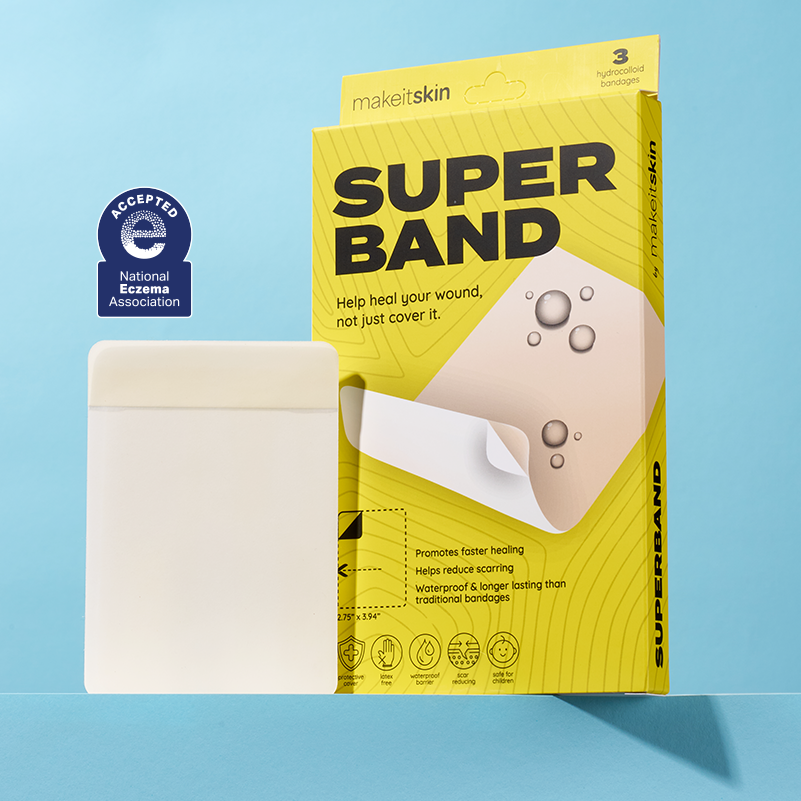
SUPERBAND Cut-To-Size
20.00 USD
Shop now
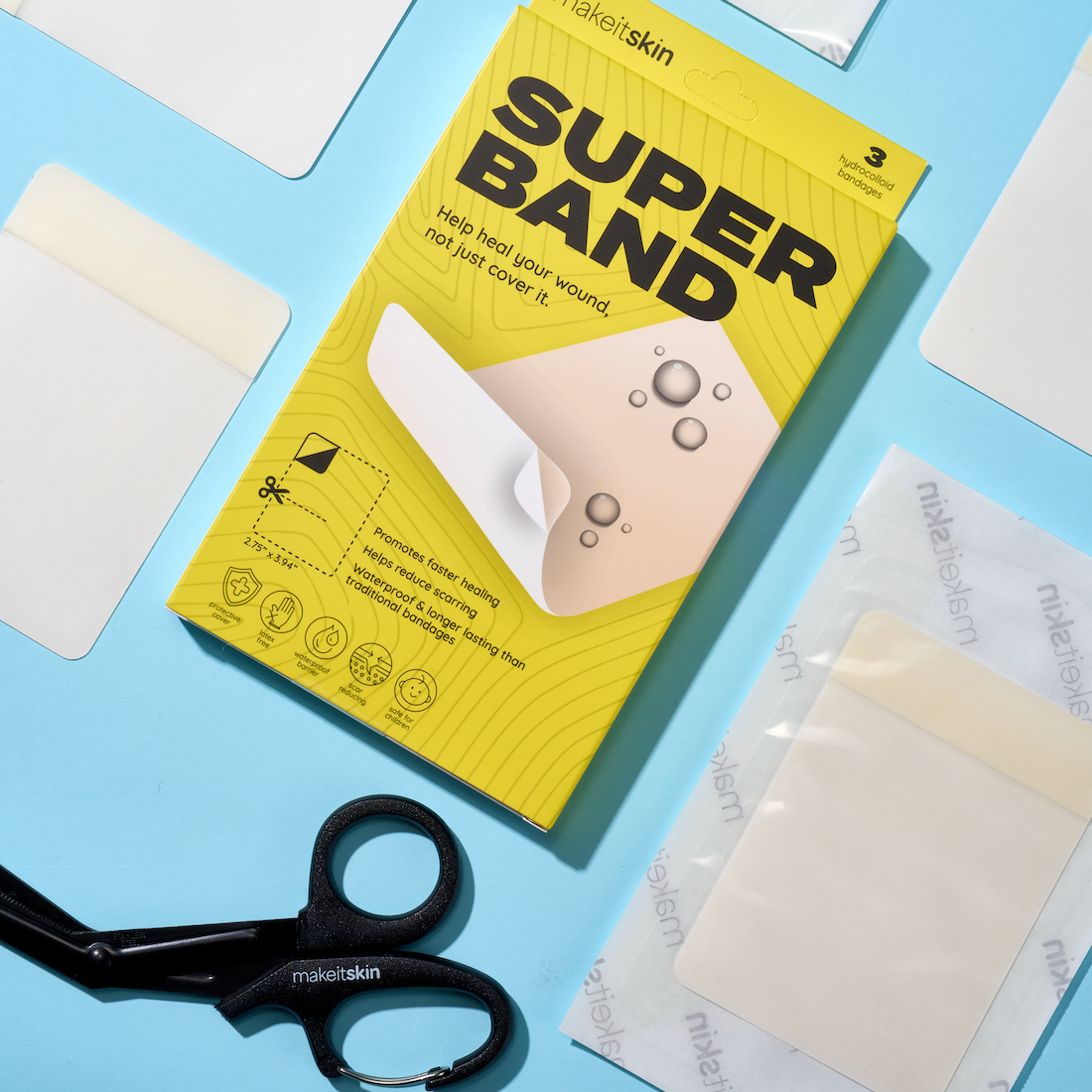
SUPERBAND Cut-To-Size Starter Kit
25.00 USD
Shop now
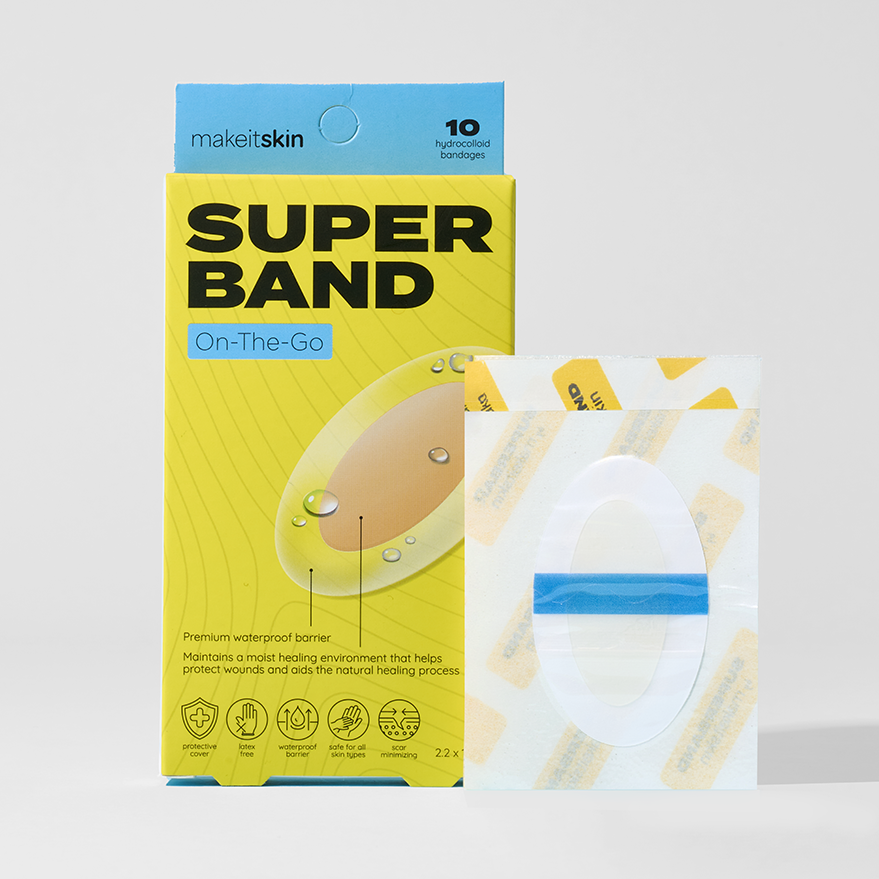
SUPERBAND On-The-Go
15.00 USD
Shop now
We are honest about the limits: hydrocolloid is one of the three adhesive chemistries named in the MARSI literature above, and no dressing is immune to individual sensitivity. If you have had a confirmed reaction to hydrocolloid dressings specifically, patch testing with a dermatologist beats guessing at another brand.
Prevention still beats covering
The cheapest blister to treat is the one that never forms. Stanford emergency physician Grant S. Lipman and colleagues, publishing in Wilderness & Environmental Medicine (2014), noted that friction foot blisters affect up to 39% of marathoners and account for more than 70% of medical visits in multi-stage ultramarathons, then tested plain paper tape on blister-prone areas of runners in 250 km desert stage races. Their follow-up multisite randomized trial of 128 stage-race runners, published in the Clinical Journal of Sport Medicine (2016), applied tape to blister-prone areas of one randomly selected foot and used untaped areas of the same foot as the control.
The everyday version of that finding is to cover the hotspot before the run. Cleveland Clinic lists the American Academy of Dermatology's prevention basics as well-fitting shoes, avoiding cotton socks that soak up sweat, and reducing friction at known problem areas. For sensitive skin, add one more habit: moisturize with a fragrance-free emollient on the days you are not covering anything, so the barrier has time to recover.
How to apply a patch that survives a long session
- Wash and dry completely. Any residual moisture or lotion under the border shortens wear time.
- Trim so the patch extends well past the sore area on all sides. The adhesive should meet healthy skin, never the wound edge.
- Round the corners. Square corners catch on socks and start the peel.
- Warm it in place. Hold your palm over the patch for about a minute so the adhesive conforms.
- Leave it alone. Change when the gel reaches the border, when the edges lift, or if you notice pain, spreading redness or discharge.
If a blister roof is still intact, Cleveland Clinic advises leaving it alone rather than popping it, since intact skin is the best barrier you have against infection.
When this stops being a self-care problem
Stop covering and get medical advice if the redness spreads beyond the dressing border, if there is pus or increasing pain, if a blister is very large or blood-filled, or if you have diabetes or circulation problems. Recurrent reactions that follow you across brands are a patch-testing conversation with a dermatologist, since that is the only way to identify which specific adhesive component is responsible.
FAQ
Are hydrocolloid patches safe for eczema-prone skin?
Many people with eczema tolerate them well, because a sealed patch removes far less often than a daily fabric strip and protects the area from scratching. Hydrocolloid still appears in the MARSI literature as one of three common adhesive chemistries, so test a small patch on calm skin before relying on one over a race weekend.
Does the white puffiness mean infection?
No. That is the gel absorbing fluid from the wound and swelling, which is how you know the dressing is loaded and near time for a change. Infection looks like spreading redness past the border, warmth, increasing pain or discharge.
Can I put a patch over an intact blister to keep running?
Yes, and covering an intact blister is generally preferable to draining it. Cut the patch large enough that its border sits on skin outside the pressure zone so the edge is not being ground into the blister with every stride.
Why does my skin only react in summer?
Heat and sweat change the equation. Prolonged moisture under a dressing softens the stratum corneum and makes it easier to strip, and the ACS Applied Bio Materials work above lists moisture-related damage and maceration alongside adhesive stripping as separate injury routes.
Do I need ointment under a hydrocolloid patch?
Generally no, and it works against you. Ointment prevents the adhesive from sealing to the skin, which shortens wear time and puts you back into more frequent removals.
If you are managing reactive skin through a training block, our related reads on hydrocolloid bandages for eczema-prone skin and wound care for athletes go deeper. If you want to start with the roll and shears together, the Cut-To-Size Starter Kit is the simplest place to begin.


