

Which Bandage Actually Stays On in the Shower?
Water alone rarely pulls a bandage off. The edge does it: soapy water lowers surface tension and creeps under any corner that is lifting, and corners lift fastest when a straight strip is stuck across a curved knuckle or heel. We ranked five widely available options on five criteria (edge seal, fit on curved skin, manufacturer-stated wear time, what the dressing does for the wound underneath, and comfort on removal), and hydrocolloid dressings take the top spots because their gel layer swells into the wound while an outer film keeps water out.
We make SUPERBAND hydrocolloid bandages, so read this the way you would read any maker's comparison: the criteria are stated up front, every competitor claim below comes from that brand's own product page, and we say where our own option is the wrong pick.
Why showers lift bandages at the edge
A shower puts three things on a dressing at once: warm water, soap, and mechanical rubbing from a washcloth or a towel. Warm water softens most pressure-sensitive adhesives. Soap is a surfactant, which means it reduces the surface tension of water and lets it spread into gaps it could not otherwise enter. The towel then peels whatever has loosened.
Consumer Reports tested a panel of waterproof bandages and found that although every product had adhesive encircling its pad, the edges did not always stay stuck to the skin, with some products forming gaps after a four-hour test; the same write-up concluded that no bandage is completely watertight and should be replaced once it gets really wet (Consumer Reports). That is the practical baseline for every product on this list.
Shape is what decides how much edge you are asking to hold. A rectangular strip laid over a knuckle has to bridge a joint that flexes through its full range several times per shower. The pad sits on the wound, and the four corners take all the movement.
How we ranked them
| Criterion | What we looked for |
|---|---|
| Edge seal | Construction that resists lifting once wet, per the manufacturer's stated design |
| Fit on curved skin | Whether the dressing can match knuckles, fingertips, heels, and elbows without overhang |
| Stated wear time | Days of wear the maker or clinical literature supports, versus daily replacement |
| Wound environment | Whether the dressing only blocks water, or also holds a moist healing environment |
| Comfort and removal | Adhesive gentleness and residue, as stated by the maker |
Weighting favors the dressings that keep a seal for days and also do something useful for the wound underneath. Covering a wound with an occlusive dressing prevents scab formation and changes how the epidermis repairs, and wounds kept moist re-epithelialize faster than wounds left to dry out (ScienceDirect, Epithelization overview).
1. SUPERBAND Cut-To-Size
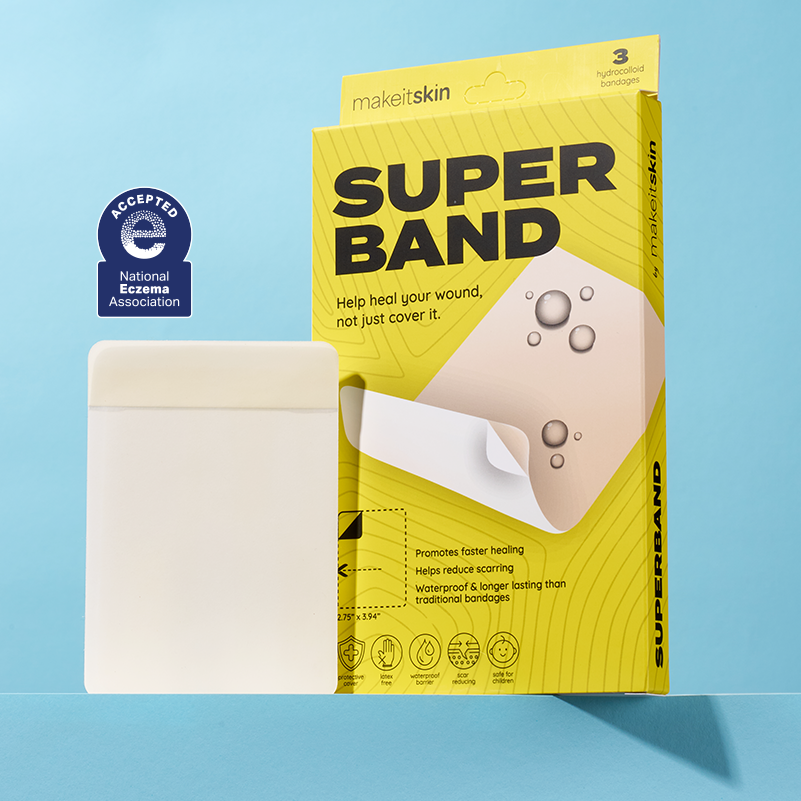
A flat hydrocolloid sheet you trim with scissors before applying. It ranks first on our stated criteria for one structural reason: you control the outline, so a fingertip wrap, a heel oval, or a knuckle bridge can be cut with generous margin on the flat skin and narrow clearance over the bend. There is no factory rectangle forcing corners into a crease.
The underlying material is the same class of dressing used in clinical wound care. Hydrocolloid dressings have two layers: an inner adhesive layer whose particles absorb exudate and form a hydrated gel over the wound, creating a moist environment that promotes healing, and an outer film or foam layer that seals the wound against bacterial contamination and debris. They are designed to be worn for up to a week, and infrequent changes are less disruptive to the wound bed (PubMed, wound care: fact and fiction about hydrocolloid dressings).
Where it is the wrong pick: you need scissors and a minute of prep, which is a poor fit for a cut you are dressing in a hurry or away from home. For that we make SUPERBAND On-The-Go in pre-cut shapes at $15, and the Precision Carabiner Shears at $10 exist because trimming a sheet with kitchen scissors is unpleasant. Cut-To-Size is $20 on our product page. We have not run a head-to-head shower endurance test against the four products below, and we are not going to imply one.
SUPERBAND Cut-To-Size
20.00 USD
Shop now
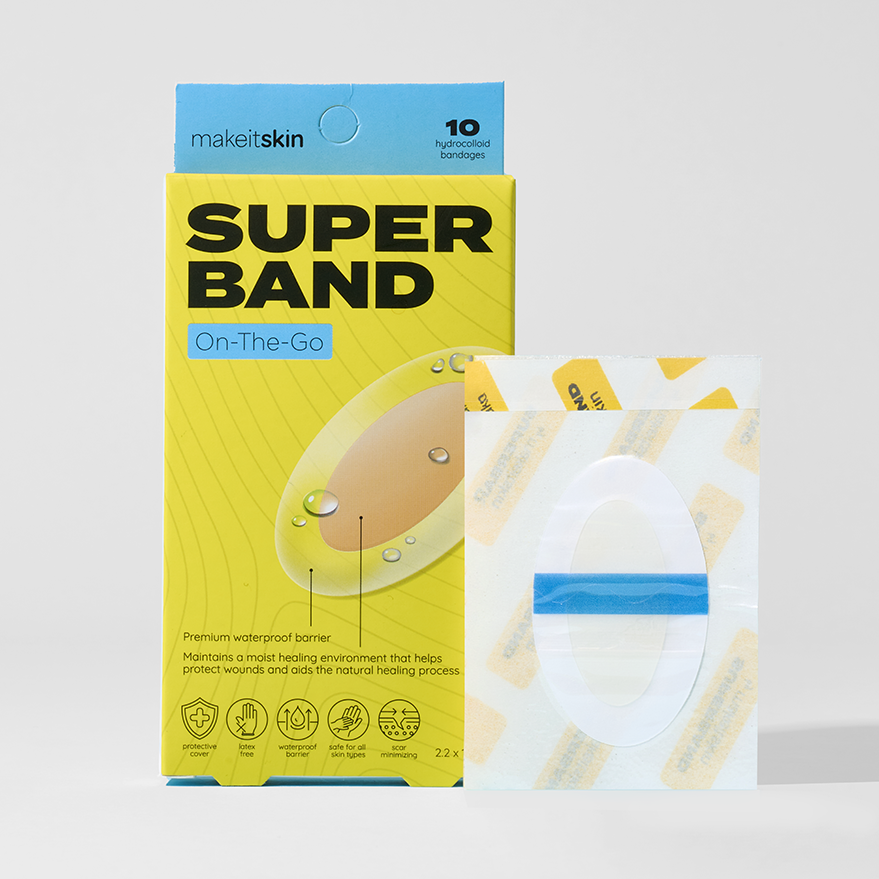
SUPERBAND On-The-Go
15.00 USD
Shop now
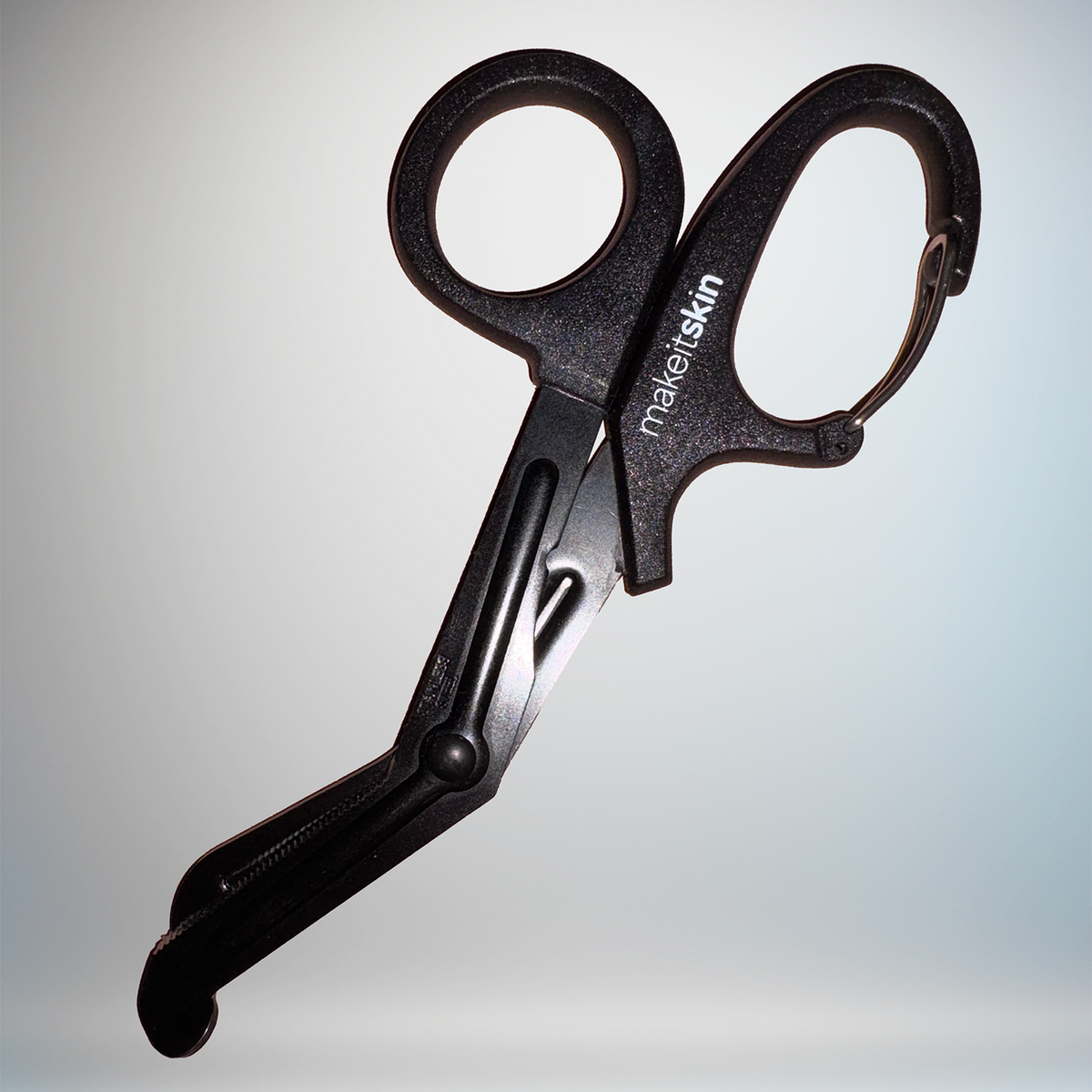
Precision Carabiner Shears
10.00 USD
Shop now
2. BAND-AID Brand HYDRO SEAL
Pre-cut hydrocolloid in fixed shapes, including finger and knuckle variants. Johnson & Johnson states that HYDRO SEAL bandages can stay on for multiple days, even through hand washing and showers, describes the product as 100% waterproof with a dual-action seal, and notes that a white bubble forms under the bandage within 24 hours to show healing has begun (BAND-AID).
It loses to a trimmable sheet only on fit. If one of the stock shapes happens to match your wound site, the practical difference between this and a cut sheet is small, and it is the faster option out of the box. That white swelling, by the way, is the gel doing its job rather than a sign of infection.
3. Nexcare Tegaderm Waterproof Transparent Dressing
A thin transparent film dressing, the same family used in hospitals. 3M states that Tegaderm dressings seal out water, dirt and germs and stay on in the shower or bath, and that the film was developed for hospital nurses so wounds can be observed without removing the dressing for days (Nexcare FAQ, Nexcare Waterproof Technology).
Film conforms beautifully to elbows and knees because it is stretchy and almost weightless. Absorption is the gap. A film dressing holds whatever fluid the wound produces against the skin without converting it to gel, so on a wound that is still weeping you can end up with pooled fluid and softened skin at the border. Choose it when you want to watch the wound, or when the site is too broad and curved for a patch.
4. BAND-AID Brand WATER BLOCK Flex
A conventional waterproof strip with a fabric-like backing and a four-sided adhesive seal around a non-stick pad. The manufacturer positions it for swimming and other water activities and directs you to apply it to clean, dry skin and replace as needed (BAND-AID).
"Replace as needed" is the honest tell. This category is built for a water event, not for multi-day wear, and the pad does nothing to hold a moist wound environment. It is a reasonable choice for a shallow scrape on a flat surface like a forearm, where you want cover for one shower and a clean strip afterward.
5. Nexcare Waterproof Clear Bandages
Clear film strips with a 360-degree seal around the pad, marketed for staying on in the bath, shower or pool, and made without natural rubber latex (Nexcare). 3M's own guidance is to change your bandage every day, or several times a day if it becomes wet or dirty (Nexcare FAQ).
Follow that instruction and you are opening the wound bed daily, which is exactly the disruption extended-wear dressings were designed to avoid. Ranked last here on the wound-environment criterion, useful on hairy skin and awkward small sites where a thin clear strip goes on easily.
Getting a seal that survives a shower
- Apply to skin that is clean and fully dry. Any residual moisture or ointment film under the adhesive is a head start for the water.
- Give the dressing margin. Clinical practice is to have the dressing extend past the wound edges on all sides so the adhesive lands on intact skin.
- Trim before you stick, not after. On a fingertip, cut a small notch in each side of the sheet so the two halves can overlap around the curve instead of buckling.
- Warm it with your palm for 30 seconds after application. Hydrocolloid adhesive softens with body heat and conforms to the skin texture.
- Turn away from the spray and pat, never rub, the dressed area dry.
- Change when the edges lift, when the gel bubble reaches the border of the dressing, or when water clearly got underneath.
When a shower dressing is the wrong problem to solve
Everything above applies to minor cuts and scrapes. Deep wounds, wounds you cannot get clean, animal or human bites, punctures, and anything with spreading redness, increasing pain, warmth or drainage need a clinician rather than a better bandage. The American Academy of Dermatology publishes plain-language guidance on caring for injured skin and when to seek care, and it is worth two minutes before you decide a wound is minor.
If you want the longer version of how the gel layer works, we wrote a full guide to choosing hydrocolloid bandages, and a companion piece on low-irritation options for sensitive skin.
FAQ
Can I shower with a hydrocolloid bandage on, or should I take it off first?
Leave it on. The outer layer of a hydrocolloid dressing is a film or foam that seals the wound from outside contamination (PubMed), and removing a dressing before every shower defeats the multi-day wear these products are designed for. Check the edges afterward and replace the dressing if any corner has lifted.
How do I know water actually got in?
Check the border first. A dressing that has taken on shower water usually shows a cloudy, wrinkled rim where the adhesive has lost contact, and the edge will feel slippery instead of tacky. Gel swelling directly over the wound is a different phenomenon and is expected.
Does a bandage work on a fingertip or a knuckle, or should I use tape?
Both work if the shape matches the joint. The practical approach on a fingertip is a trimmed piece with notches cut into the sides so it wraps without a ridge, and on a knuckle, a narrow bridge across the joint with wide anchors on the flat skin either side. Tape over a pad is a fallback when the site is too large for any patch.
Are waterproof strips and hydrocolloid bandages the same thing?
They solve different halves of the problem. A waterproof strip blocks water and asks to be replaced as needed (BAND-AID); a hydrocolloid dressing blocks water and converts wound fluid into a gel that keeps the wound bed moist while it heals (PubMed).
How long can one dressing stay on?
Hydrocolloid dressings are designed for wear up to about a week, with less frequent changes causing less disruption to the wound bed (PubMed). Film strips from 3M's Nexcare line carry daily-change guidance instead (Nexcare FAQ). Either way, replace a dressing that has lifted, soaked through, or reached its absorption limit.
Trimming to shape is the part most people skip, and it is the part that decides whether the edge holds. If your cut is somewhere awkward, start with a SUPERBAND Cut-To-Size sheet and a pair of shears; if it is somewhere ordinary and you want it covered in ten seconds, On-The-Go is the simpler answer.


