

Best Hydrocolloid Bandages: How to Choose (2026)
Hydrocolloid bandages are designed to support minor wound healing by holding wound fluid against the skin instead of letting it dry into a scab — a mechanism with decades of clinical support, though individual results vary. Seal matters: a dressing that lifts at the edge stops being occlusive. For 2026 we compare hydrocolloid options on how well they can be fitted to the real shape of a wound, which is one reason a trimmable sheet suits irregular sites like knuckles, fingertips and heels — without claiming it heals faster than every alternative.
We make SUPERBAND, so start with that disclosure. This guide weighs fit and seal heavily, because fit is where many hydrocolloid bandages struggle in a normal week: a rectangle over a knuckle, a circle over the side of a fingertip, an oval that ends halfway across a scrape. When an edge lifts, the seal is compromised and the moist environment can vent — which may reduce the benefit the dressing provides, though it does not automatically undo healing already underway.
What "faster healing" is actually referring to
The claim traces to a single well known experiment. In 1962, George Winter covered partial thickness wounds on pigs and left matched wounds open to the air, and the covered wounds re-epithelialized faster. The idea that a moist wound environment accelerates healing came out of that work and reshaped clinical dressing practice (PubMed).
Hydrocolloid dressings are one commercial expression of that principle. They are built from gel-forming agents such as gelatin, pectin and carboxymethylcellulose, and when they meet wound exudate they absorb it and form a gel that keeps the wound bed moist (Frontiers in Pharmacology, 2020). That gel commonly forms as the dressing absorbs wound fluid — it is not by itself a sign of infection, but its appearance alone also cannot confirm the wound is healing normally; see the FAQ below for the signs that do warrant attention.
A 2025 narrative review in the dermatology literature is careful about how far the evidence goes: hydrocolloid dressings appear effective in acute wounds with the potential for reduced healing time and easier application compared with traditional dressings, while most research on pressure ulcers and on preventing hypertrophic and keloid scars found similar efficacy to standard dressings rather than a clear advantage (PMC, 2025). We think that nuance matters. The strong case for hydrocolloid on a kitchen cut is the moist environment, the cushioning, and the fact that you leave it alone for days instead of ripping a dry pad off a healing surface every morning.
The American Academy of Dermatology reaches the same practical conclusion by a different route. Its wound care guidance tells people to keep an injury moist, because wounds that dry out and form scabs take longer to heal, and it recommends sun protection on the healed skin afterwards to limit discoloration (AAD).
AAD's minor cut instructions say to change the bandage daily (AAD), while hydrocolloid manufacturers, including us, tell you to leave the dressing on for multiple days. Both are right for their product. A gauze pad needs daily inspection because it dries onto the wound and gives you no view of what is happening. A hydrocolloid is designed to be left in place until the gel reaches the edge of the dressing or the border starts lifting, and every unnecessary removal costs you adhesive contact with the skin around the wound.
How to choose
A few practical checks, not weighted scores:
- Seal over the actual wound shape. Can the dressing cover the wound plus a clean margin of intact skin on every side? Check this first, since everything else depends on it.
- Wear time under water, sweat and friction. Does it survive showers, dishes and a workout without the border rolling?
- Adhesive gentleness. How does the skin look after removal, and how many removals does the wound require in total?
- Portability. Can you carry it in a bag, a pocket or a glovebox and use it without a flat surface?
- Cost per usable dressing. Pack price hides how many pieces you actually get out of it.
This is a brand-authored selection guide, not an independently tested ranking. Only SUPERBAND Cut-To-Size is our product; the retail pad and the shaped blister cushions below are included for context, not head-to-head comparison. If your typical injury is a flat, simple cut on a forearm, Cut-To-Size may be more than you need — the retail pad may be the simpler choice.
SUPERBAND Cut-To-Size: the customizable option
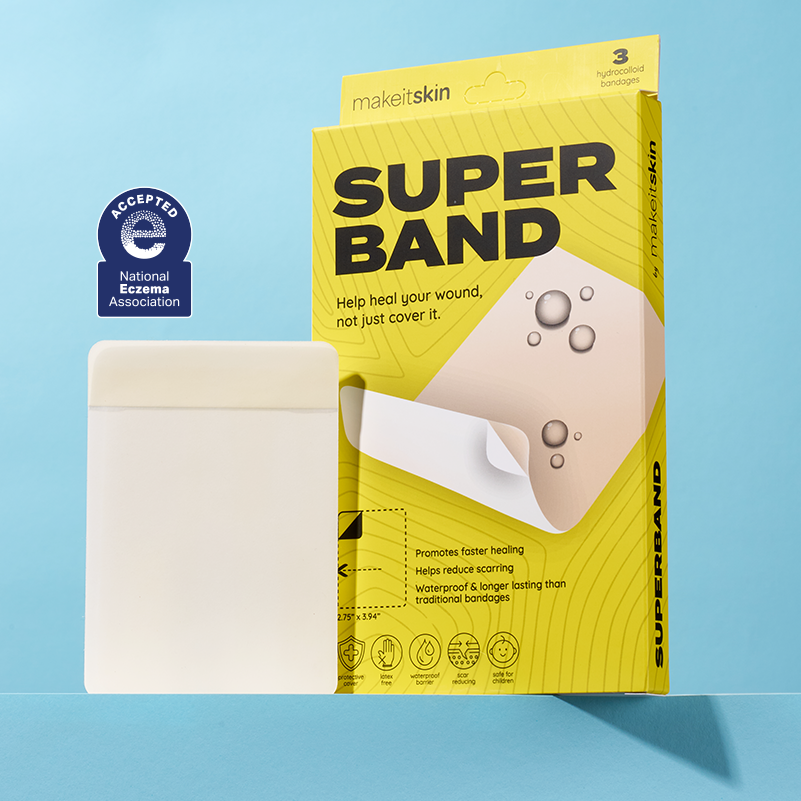
Twenty dollars for a flat sheet you trim. Here's what the format itself offers: it lets you match the dressing to the wound instead of the other way around. A knuckle needs a shape with room to flex. A fingertip wrap needs length, not width. A scraped shin needs a piece bigger than any pre-cut pad in a drugstore box. Cutting your own gives you a consistent margin of intact skin on all sides, and that margin is what helps hold the seal.
It is waterproof and formulated to be low-irritation, and we designed it with eczema-prone and sensitive skin in mind — though no adhesive bandage is a guaranteed fit for every skin type, so patch-test a small piece first if you're unsure. There's a real trade-off with wear time: fewer removals can mean less mechanical stripping of the skin, but longer occlusion can also irritate or macerate skin that's already reactive, and tolerance varies person to person. If you have a known adhesive allergy or active eczema, get clinical advice before use, and stop if you notice irritation.
The trade-off: you need clean scissors and about twenty seconds. In a first aid situation with one usable hand, that is a real cost, and it is why the next two entries exist. It also handles low to moderate exudate, which is the normal range for household cuts and scrapes; minor burns need extra care and, per AAD guidance, some should be seen by a clinician rather than self-treated. A heavily weeping wound needs a different dressing class and probably a clinician.
For portability without cutting, we also make SUPERBAND On-The-Go ($15), a pre-cut version of the same hydrocolloid in a pack you can carry. It is not covered as a separate item here — it is the same material in a different format, not a distinct option to weigh against the others, so think of it as the portable companion to the sheet above. The Cut-To-Size Starter Kit at $25 bundles the sheet with the shears you need to trim it, and the Precision Carabiner Shears clip to a bag for $10 on their own.
SUPERBAND Cut-To-Size
20.00 USD
Shop now
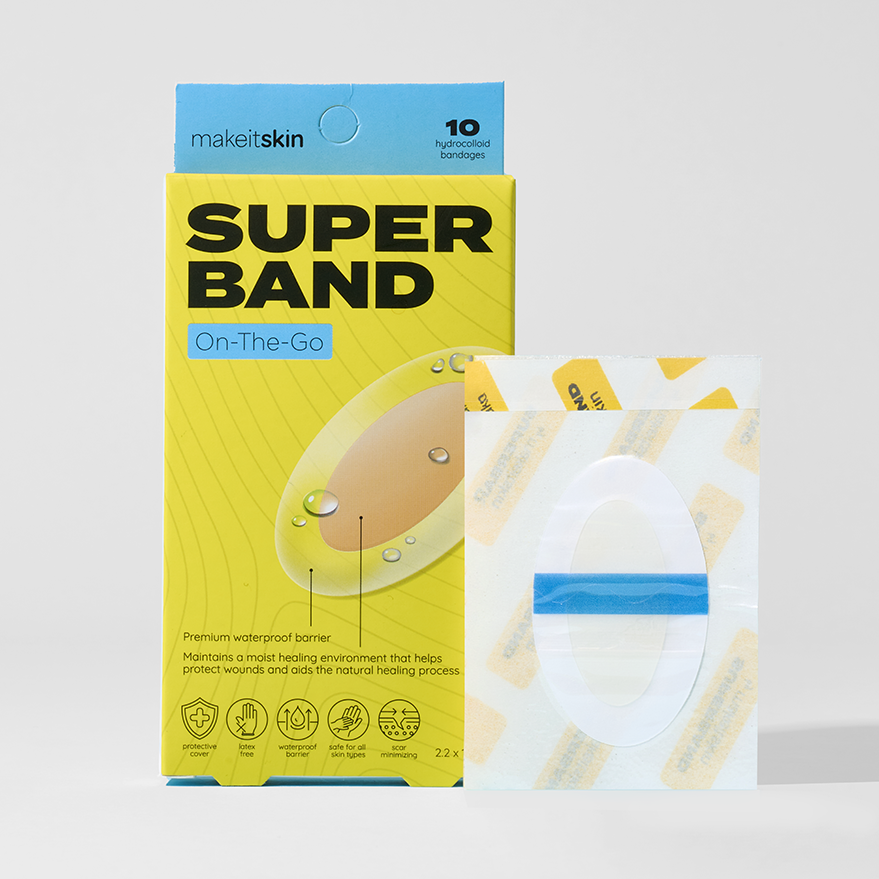
SUPERBAND On-The-Go
15.00 USD
Shop now
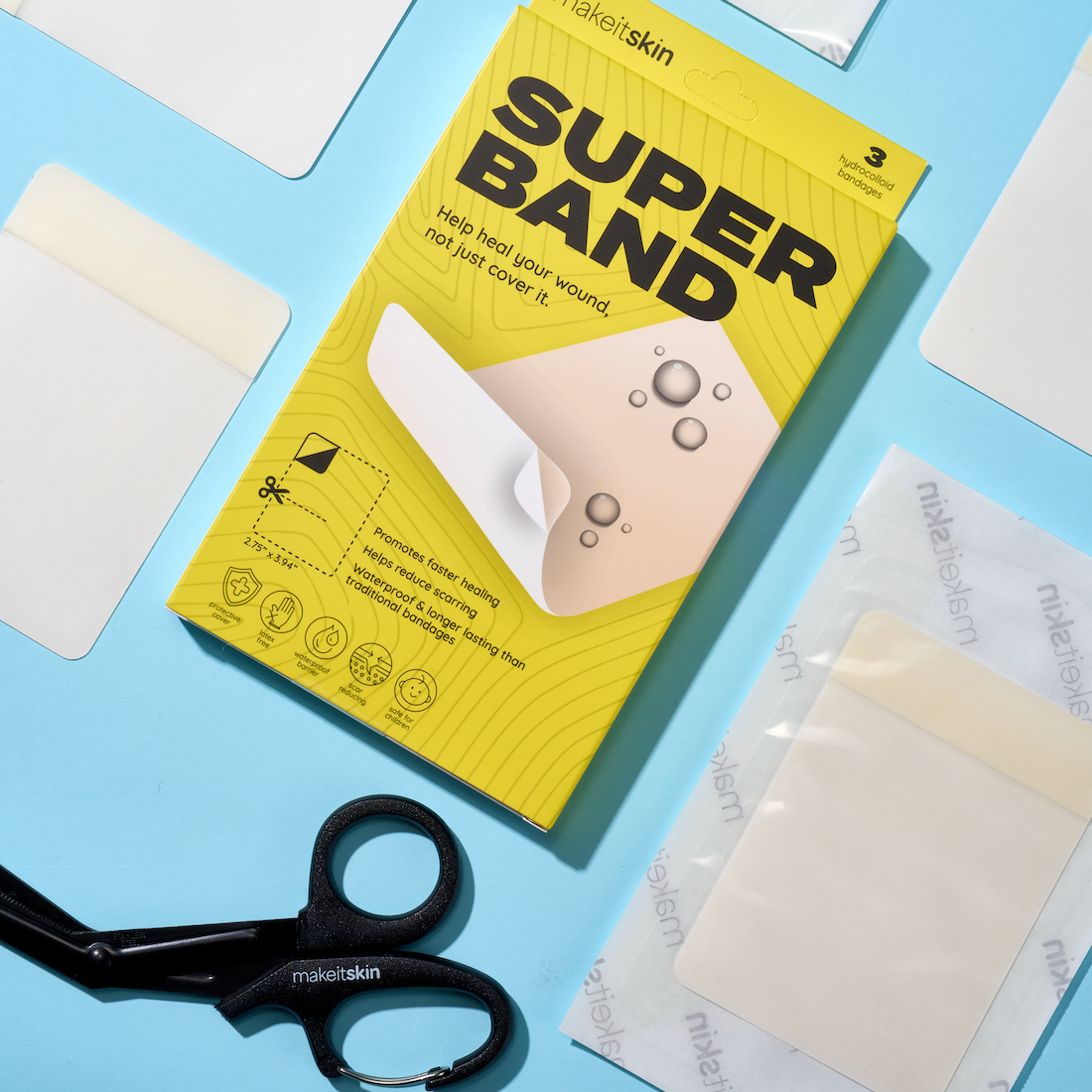
SUPERBAND Cut-To-Size Starter Kit
25.00 USD
Shop now
Pre-cut retail option: BAND-AID Brand Hydro Seal, All Purpose
The default retail hydrocolloid in the United States, widely available and already cut into standard shapes. BAND-AID Brand describes it as fully waterproof, cushioning, and showing a white bubble within 24 hours of application to indicate that healing has begun (BAND-AID).
If your wound matches one of its labeled shapes, this is a perfectly good choice and you can buy it at any pharmacy tonight — its correctly labeled shapes fit the wounds they're made for. Check your own wound against the package shape before buying: on a knuckle or a fingertip crease, a fixed pad may bridge the joint awkwardly or leave part of the wound uncovered, in which case a piece trimmed to size may seal more consistently.
Shaped blister cushions for feet
Foot blisters fail differently from cuts: friction attacks the border of the dressing all day. BAND-AID's heel version is shaped for the heel specifically and ships as six individually wrapped cushions measuring 1.1 by 2.1 inches (BAND-AID); Compeed built its reputation on the same idea. The shaped cushions handle the classic heel-cup blister well.
For a blister in a spot these fixed shapes weren't designed for — the second toe joint, along the arch, under a shoe eyelet — check the package shape against the wound first; if it doesn't line up, a piece trimmed from a sheet can be cut to match that specific spot. We wrote about the sensitive-skin side of this in low-irritation blister patches for sensitive skin.
Where hydrocolloid is the wrong call
Skip it and get help if the cut is longer than three quarters of an inch, deeper than a quarter inch, or will not stop bleeding (AAD). Skip it on an obviously infected wound, on a deep puncture, on an animal bite, and on anything beyond a superficial burn.
Skip it, too, when the wound is still bleeding or the surrounding skin is wet. Hydrocolloid adhesive needs dry intact skin, and the most common reason a patch fails on day one is that it was applied to a surface that was not dry.
Getting the seal right
- Rinse the wound under running water and wash around it with mild soap. Hydrogen peroxide and iodine both irritate the wound bed, so leave them out (Mayo Clinic).
- Dry the surrounding skin completely, giving it a few seconds longer than feels necessary.
- Skip ointment underneath. Creams and petroleum jelly stop the adhesive from bonding, and the hydrocolloid is doing the moisture job that the ointment would otherwise do.
- Cut a piece with a clear margin of healthy skin on all sides, then warm it against the skin with your palm for about 10 to 15 seconds, per the product's usage directions, before you move.
- Leave it alone. Change it when the gel spreads to the edge of the dressing or a border starts to lift.
FAQ
Is the white bubble under the patch a sign of infection?
Not by itself. In most cases that is the hydrocolloid absorbing wound fluid and forming a gel, which is how the dressing maintains a moist wound bed (Frontiers in Pharmacology, 2020). But the gel bubble alone doesn't rule out infection — keep watching for spreading redness beyond the dressing, warmth, swelling, increasing pain, or fever, and see a clinician if any of those appear, rather than relying on the bubble's look alone.
Will a hydrocolloid bandage prevent a scar?
It supports the conditions dermatologists associate with better cosmetic outcomes, which is a moist wound bed rather than a dry scab (AAD). The published evidence on hydrocolloids specifically preventing hypertrophic and keloid scars mostly shows similar results to standard dressings (PMC, 2025), so we describe the mechanism honestly and stop there. After the skin closes, sun protection on the new tissue is the step most people skip.
Can I put one on before a shower or a workout?
Yes, and that is one of the main reasons to choose this format. Apply it to clean dry skin and give the adhesive a few minutes to bond before water or sweat reaches it. If you are heading into heavy friction at the same site, trim a larger piece so the border sits well outside the rubbing zone.
Are these safe on eczema-prone or sensitive skin?
We designed SUPERBAND to be low-irritation, with eczema-prone and sensitive skin in mind, but there's no universal low-irritation guarantee — tolerance varies by person. Fewer removals may reduce mechanical stripping of the skin, but longer occlusion can also irritate or macerate skin that's already reactive, so the trade-off runs both ways. Do not apply a patch over actively inflamed eczema itself; if you have a known adhesive allergy or active eczema, get clinical advice before use, and stop if you notice irritation.
How does this compare to just using petroleum jelly and a regular bandage?
Petroleum jelly under a standard bandage is the approach AAD describes for minor cuts, and it works (AAD). The difference is maintenance: standard dressings typically need changing per the package directions, and more often once they get wet or dirty — during dishwashing, showering or a run, for example. A hydrocolloid is designed to hold its seal through water and activity for longer, but check your own dressing's border and change it if it lifts or gets contaminated, regardless of type.
Where to start
If you want one thing, take the sheet and a pair of shears and keep them in the kitchen: the SUPERBAND Cut-To-Size Starter Kit. If you want the version that lives in a bag, take SUPERBAND On-The-Go.


