

Blister Prevention for Marathon Training: Patches & Tape
Blisters form when repeated shear separates the layers of your skin, so the only reliable fix is to lower that shear on the exact spot before the bubble lifts. Plain paper tape applied to known hot spots before a run has the strongest published prevention evidence in endurance runners, and a pre-cut waterproof hydrocolloid patch is the practical thing to carry for a hot spot that appears mid-run. If a blister does form and the roof is intact, cover it and leave the roof alone.
Most runners treat blisters. The ones who stay comfortable through a marathon build prevent them, usually by knowing the two or three places their feet always complain and covering those places before the shoe goes on. Friction foot blisters occur in up to 39% of marathoners, according to Lipman and colleagues writing in Wilderness & Environmental Medicine (2014), and they account for the majority of medical-tent visits in multi-stage ultras. That is a big number for an injury that responds to about thirty seconds of preparation.
We make hydrocolloid bandages, so we have an obvious interest here. We have tried to write the ranking the way we would want to read it: evidence first, our own product where the criteria actually put it.
How we ranked these
Six criteria, applied to every entry below:
- Published prevention evidence. Has anyone tested this in runners or soldiers, or is it just popular?
- Staying power through sweat and water. A dressing that lifts at mile 8 is worse than nothing, because the loose edge becomes its own friction source.
- Fit on the spot that actually hurts. Heel cup, toe joint, arch and the side of the big toe are different shapes.
- Can you apply it mid-run? Some options only work if you prep before the run.
- Skin irritation on removal. Repeated stripping of the same patch of skin causes its own damage.
- Cost and US availability at Amazon, CVS, Target and Walmart.
What a blister actually is
A friction blister is mechanical. Repeated rubbing produces shear stress that tears the skin apart within the epidermis, and fluid fills the resulting space. Medscape's clinical reference on friction blisters describes them as the result of frictional forces between the skin and whatever it contacts, with secondary infection as the complication that makes them worth taking seriously.
Three things stack the odds against your feet on a long run. Shear rises when your foot moves inside the shoe. Moisture from sweat softens the stratum corneum and raises the coefficient of friction. Heat builds in the shoe over hours. That is why a hot spot at mile 6 of an easy run becomes a lifted blister at mile 18 of a long one.
Skin is also trying to help you. As Shilpi Khetarpal, MD, a dermatologist at Cleveland Clinic, put it, "Blisters are your body's way of forming a bandage after an injury." The roof is a sterile cover. Keeping it is usually the goal.
1. Plain paper tape, applied before the run
This is the least glamorous option and the one with the best data behind it.
In a multisite randomized trial published in the Clinical Journal of Sport Medicine in 2016, Grant Lipman, MD, of Stanford University School of Medicine and colleagues taped one randomly selected foot of 128 runners in 250-km six-stage RacingThePlanet ultramarathons, applying tape to each runner's blister-prone areas and using untaped areas of the same foot as the control. A clinical commentary in Podiatry Today (2016) summarizing the trial reported that 83% of participants developed blisters and that paper tape reduced blister risk by 40%.
The earlier 2014 trial from the same group compared a taped foot against the untaped opposite foot and found no significant protection, and the authors noted only that the intervention was well tolerated. And the 2016 protocol taped blister-prone areas specifically, not whole feet.
Lipman explained the mechanism to Fox News: "Paper tape is a very smooth thin tape, it causes easier sliding at the skin interface," which lowers the shear stress under the tape, and its weak adhesive means pulling it off will not tear the roof off a blister that formed underneath. The U.S. Army Public Health Center blister prevention fact sheet reaches the same practical conclusion, listing 3M Micropore paper tape among skin coverings shown to reduce blister occurrence.
Where it falls short: paper tape is not waterproof, it does not survive a river crossing or a sweat-soaked sock for long, and it is a prevention tool only. Once a blister has lifted or opened, paper tape is the wrong dressing. You also have to know your hot spots in advance, which means a training block, not race morning.
Cost: a few dollars a roll at CVS, Walgreens, Target and Amazon.
2. SUPERBAND On-The-Go: the patch that lives in your race belt
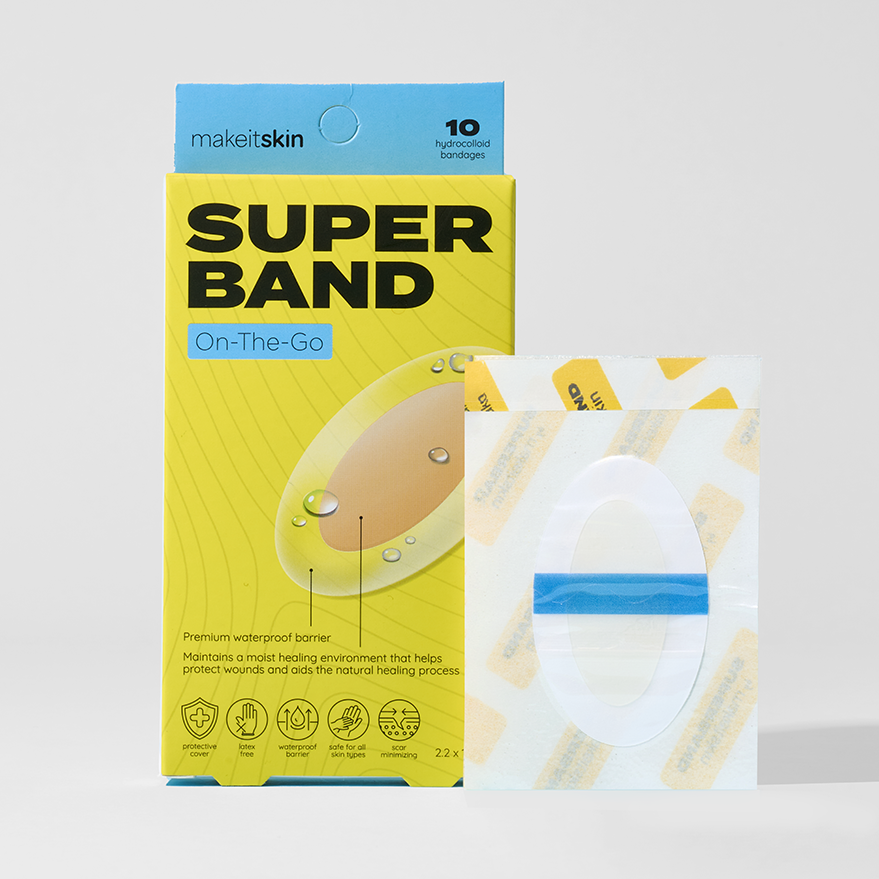
Pre-cut waterproof hydrocolloid, ten patches to a pack, $15. This is the MAKEITSKIN product built for exactly the moment paper tape cannot help you: mile 9, a hot spot on the outside of the heel, no scissors, no sheet, no flat surface to work on.
Hydrocolloid behaves differently from tape. The 2025 narrative review of hydrocolloids in dermatology describes the dressing forming a gel-like protective layer as it absorbs fluid, creating a moist environment associated with reduced healing time in acute wounds compared with traditional dressings. In practice that gives you a cushion that stays put through sweat and a shower, and it stays useful whether the skin is intact, a hot spot, or a blister that has already lifted. Medscape notes that hydrocolloid dressings decrease discomfort and encourage healing in friction blister management.
Our patches are low-irritation and eczema-safe, which matters more than it sounds during a marathon build. The damage many runners blame on the blister is adhesive damage from covering and stripping the same square inch every day. We wrote about the removal-frequency problem in more detail in our guide to low-irritation blister patches for sensitive skin.
Where it falls short, honestly: there is no randomized trial of SUPERBAND specifically for blister prevention, so the evidence tier here is the general hydrocolloid literature plus the mechanical logic of covering a hot spot, not a trial of our product. Adhesion depends on applying it to skin that is clean and dry, which is hard mid-run. If you are already three hours into a sweaty race, dry your foot with a sock or a shirt hem before you stick anything to it. Pre-cut sizes also will not conform to every awkward spot.
Cost: $15 for the pack at makeitskin.com.
3. Compeed: the shaped incumbent
Compeed's blister care line is shaped hydrocolloid, with dedicated heel and toe shapes, and it has been a fixture of drugstore blister aisles for years. Shaped pads and a strong adhesive are a genuine advantage on the classic heel blister, where a rectangle wants to peel at the curve.
The same strength is the drawback. A firmly adhered plaster is difficult to remove early without taking skin with it, so the standard advice is to leave it until it starts to lift on its own. The shapes also constrain you: if your problem is the joint of the second toe or a strip along the arch, a heel-shaped pad is the wrong tool.
Best for: a known heel blister, especially if you want one dressing to stay on for days.
4. BAND-AID Hydro Seal: the one you can buy at 9pm
Hydrocolloid blister cushions from BAND-AID, stocked in effectively every CVS, Target and Walmart. Same class of material as entries 2 and 3, packaged in a small number of pre-set shapes.
The reason it sits below the two entries above on our criteria is fit range and portability rather than the material itself. It is a fine choice, and if you are traveling to a race and forgot everything, it is the one you will actually find.
5. Nexcare waterproof coverings
3M's consumer bandage line covers the "keep it sealed" job with waterproof film-style bandages, and 3M is also the manufacturer of the Micropore paper tape at number one. Film coverings are thin and water-resistant, which is useful for keeping an existing dressing or a small wound sealed in the shower.
They are thin by design, so they contribute little cushioning against shear. Think of them as a seal rather than a pad.
6. Anti-chafe balms: Body Glide, Squirrel's Nut Butter, 2Toms
Lubricants attack the same variable from the opposite direction, reducing friction rather than absorbing shear. Runners love them, and for thigh and underarm chafing on a long run they earn that loyalty.
For foot blisters over marathon distances the evidence is less kind. The Army Public Health Center fact sheet states that lubricating substances require routine reapplication, and that within one hour protective benefits return to normal, followed by an increase of 35% over normal. Skin absorbs the lubricant and ends up moister, which is the condition you were trying to avoid. The same fact sheet notes that powders such as 2Toms BlisterShield reduce near-surface skin hydration, a different and potentially more durable approach for sweaty feet.
Antiperspirants on the feet have been studied too, with modest results: a 2016 review of topical anti-blister products reports that Knapik and colleagues (1998) found a 12% reduction in blister risk with antiperspirant use, alongside a degree of skin irritation.
Verdict: excellent for chafing, unreliable as your only foot-blister strategy past the first hour.
7. Kinesiology tape and zinc oxide tape
KT Tape and similar elastic kinesiology tapes, plus rigid zinc oxide athletic tape, are widely used for hot spots. The Army fact sheet lists moleskin and zinc oxide or kinesiology tapes among products that "have been purported" to reduce blisters, wording that is doing real work: the supporting evidence is weaker than for paper tape.
The practical objection is adhesion. Strong athletic tape that has bonded to skin over four hours can take the blister roof with it when you remove it, which is precisely the outcome paper tape avoids. Elastic tape also wrinkles under load, and a wrinkle is a shear concentrator.
Side-by-side comparison
| Option | Mechanism | Prevention evidence | Sweat and water | Apply mid-run? | US retail |
|---|---|---|---|---|---|
| Paper tape (3M Micropore) | Low-friction smooth surface reduces shear | Strongest: 2016 randomized trial, 40% risk reduction reported | Poor | Awkward, needs dry skin and a flat sit-down | ~$3-8, drugstores, Amazon |
| SUPERBAND On-The-Go | Hydrocolloid gel pad absorbs fluid, cushions shear | General hydrocolloid literature; no product-specific trial | Waterproof | Yes, that is the design | $15 for 10, makeitskin.com |
| Compeed | Shaped hydrocolloid, strong adhesive | Category-level; shaped for heel | Good | Possible, shape must match | Drugstores, Amazon |
| BAND-AID Hydro Seal | Hydrocolloid cushion | Category-level | Good | Possible | CVS, Target, Walmart |
| Nexcare waterproof | Thin film seal | Not a shear-reduction claim | Good | Yes | CVS, Target, Amazon |
| Body Glide / SNB / 2Toms | Lowers surface friction | Benefit fades within about an hour, then friction rises | Washes off | Yes, easy | Run shops, Amazon |
| KT Tape / zinc oxide | Anchoring and coverage | Purported, weaker support | Moderate | Difficult | Amazon, Target |
Socks, shoes and the things tape cannot fix
No patch rescues a shoe that lets your foot slide. Two upstream fixes do more than any dressing:
- Socks. Medscape summarizes work showing that socks with low friction against foot skin reduced plantar shear more than socks with low friction on the outer surface. Synthetic or wool running socks, not cotton.
- Fit and lacing. A heel that lifts is a heel that shears. A runner's loop through the top eyelets is free and takes ten seconds.
Then tape the two or three spots that still complain. Prevention is targeted, not comprehensive: the AAD's advice to pay attention to your skin and take precautions before a lot of walking or running is exactly the habit that separates runners who blister from runners who do not.
Build the kit: gym bag, long run, race day
Gym bag (stays in the bag, restocked monthly): a roll of paper tape, a pack of pre-cut hydrocolloid patches, a few plain adhesive bandages, alcohol wipes, small blunt scissors.
Long run, in a pocket or belt: two or three pre-cut hydrocolloid patches and nothing else. Weight and fuss decide what you actually carry, and a sheet plus scissors does not survive that test.
Race morning, applied at home: tape or patch your known hot spots before your socks go on, on clean dry skin. Carry two spares for the ones you did not predict.
For genuinely odd shapes, the pre-run prep option is a roll you cut yourself. SUPERBAND Cut-To-Size ($20) with the Precision Carabiner Shears ($10) lets you make a strip that wraps a toe joint or lines a heel cup, and the Starter Kit ($25) pairs the roll and shears together. Cut those at the kitchen table, not at the aid station.
SUPERBAND On-The-Go
15.00 USD
Shop now
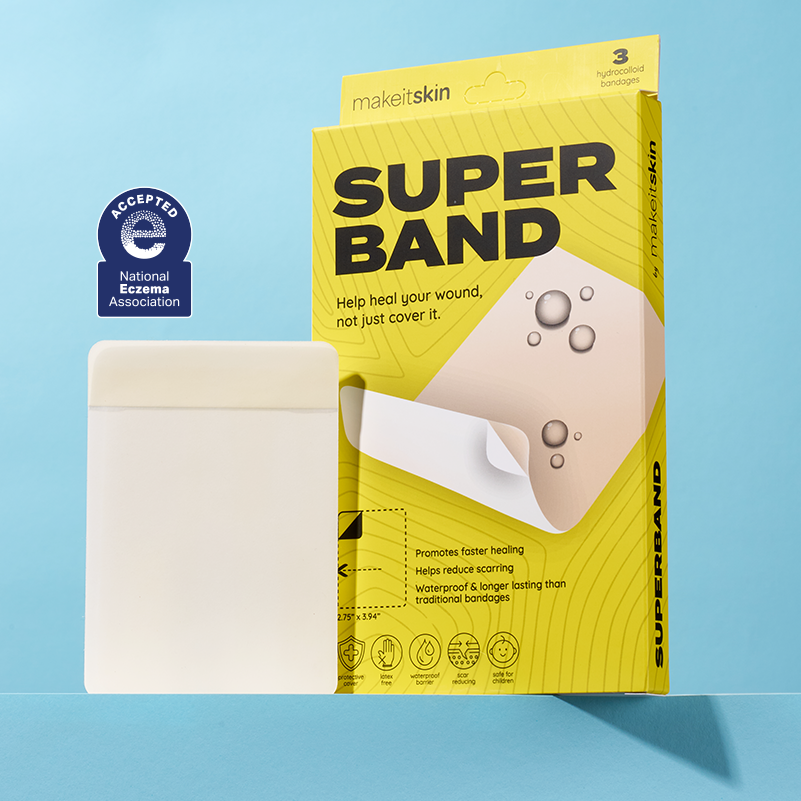
SUPERBAND Cut-To-Size
20.00 USD
Shop now
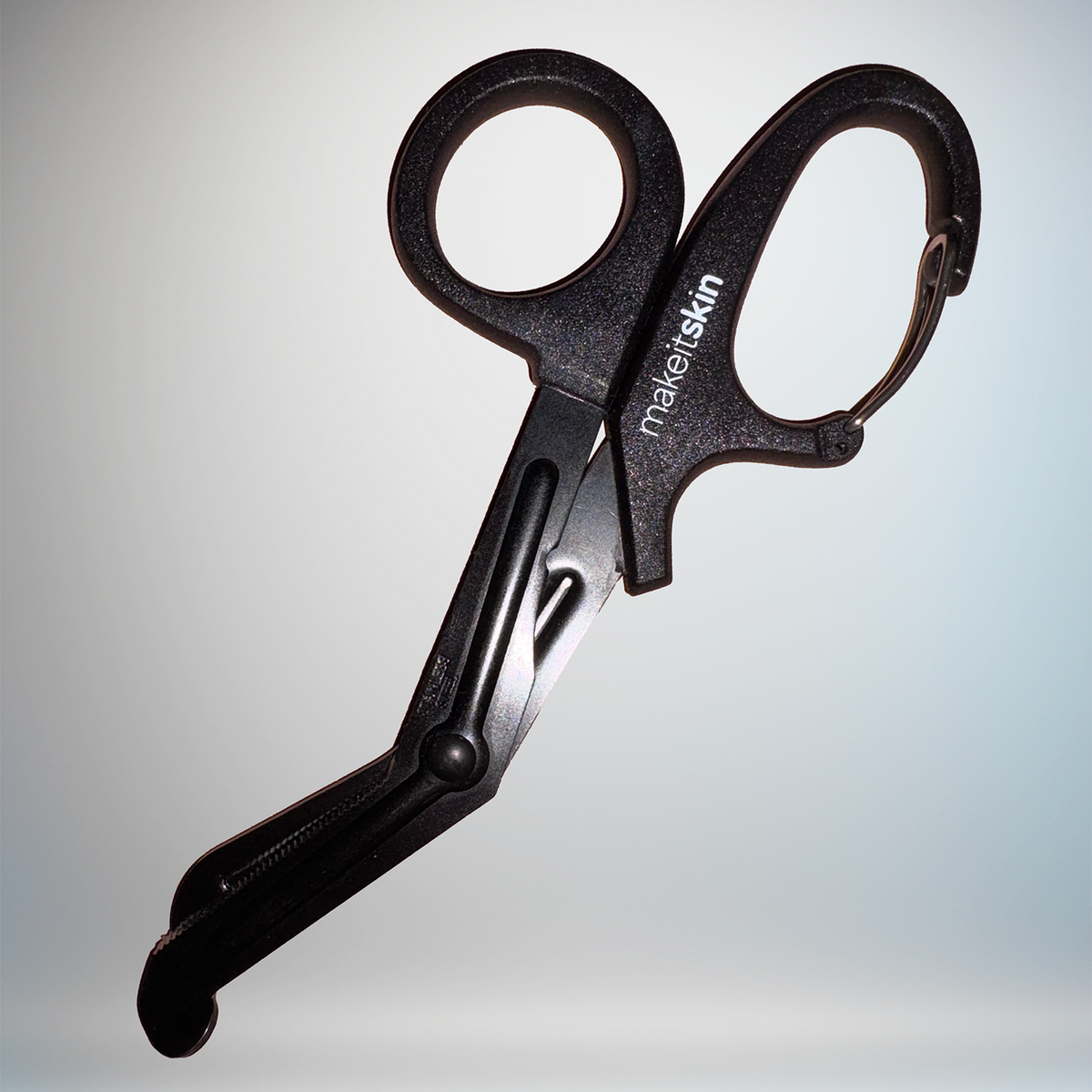
Precision Carabiner Shears
10.00 USD
Shop now
If the blister already opened mid-run
Clean it as well as your situation allows, then cover it. An open blister is an open wound, and the goal shifts from prevention to protection.
The roof matters. The AAD advises against removing the roof of a blister, because that flap protects the raw skin underneath while it heals, and Medscape's management guidance is the same: leave the roof intact to serve as a dressing over the site. If loose skin is flapping and catching, trim only the part that has already torn free, and leave what is still attached.
A hydrocolloid patch is a reasonable cover for a deroofed friction blister once the area is clean, since it keeps the surface moist and cushioned. Change it when it lifts or when the gel pad has fully whitened and reached the edges.
When to stop self-treating
See a clinician if you have diabetes or any condition affecting foot sensation or circulation, or if the blister is very large, deep, blood-filled, or the result of a burn rather than friction.
Stop and get it looked at for signs of infection. The AAD lists redness, pus, or increased pain or swelling as reasons to see your doctor or a board-certified dermatologist. Red streaks spreading from the site, warmth, or fever mean the same day, not next week.
A dressing covers a wound. Infection is a clinician's job, and no patch changes that.
FAQ
Should I pop a blister?
Usually no. The AAD advises avoiding popping or draining a blister because of the infection risk, while acknowledging that a large and very painful one may need to be drained. If you do drain it, their instructions are to sterilize a small needle with rubbing alcohol, pierce one edge, let the fluid out, and leave the roof in place. Mid-race, the calculation shifts toward draining only when the pressure is genuinely stopping you.
How do I stop heel blisters during marathon training?
Fix the slide first: heel lock lacing, a shoe that holds the heel, and synthetic or wool socks. Then tape the specific spot before every long run once you know where it happens. Paper tape on blister-prone areas is the intervention with the best trial support; a hydrocolloid patch is the more durable option if you sweat heavily or run in wet conditions.
Will a patch stay on through a sweaty long run?
A waterproof hydrocolloid patch is designed to, provided you apply it to dry skin and press the edges down for several seconds before your sock goes on. Application on damp skin is the usual reason a patch peels. Paper tape will not survive the same conditions.
What if I only notice a hot spot at mile 15?
Stop for ninety seconds if the course allows. Dry the skin, cover the spot with a pre-cut patch, and keep running. A hot spot is a blister that has not finished forming, and covering it is far cheaper than the alternative at mile 20.
Patches or tape? Which should I actually buy?
Both, for different jobs. Tape is preventive and cheap, applied at home to spots you already know about. Patches are protective and portable, and they still work after a blister has formed. If you buy one thing for a marathon build, buy the roll of paper tape. If you buy one thing to carry in a race belt, buy pre-cut hydrocolloid.
Do anti-chafe balms prevent foot blisters?
They help for the first stretch and for skin-on-skin chafing, but the Army Public Health Center notes the protective effect of lubricants fades within about an hour, with friction then rising above baseline. Use balm for thighs and underarms, and something mechanical on your feet.
Ready to put something in the race belt? The SUPERBAND On-The-Go 10-pack is $15 and fits in a shorts pocket.


