

Waterproof Bandages for Cooking Burns: Dish-Sink Guide
A bandage that holds through a shower can still lift at the sink, because dish soap is a surfactant and surfactants lower the surface tension of water so it wicks into any small flaw in an adhesive seal. For a minor kitchen burn, cool and clean it first, then cover it with a waterproof hydrocolloid dressing whose outline actually follows the burn, with no corners standing off a knuckle or a fingertip. Below we rank four dressing types on four stated criteria and walk through trimming a sheet to fit.
We make SUPERBAND hydrocolloid bandages, so we have a stake in this answer and we would rather be useful than coy about it. The mechanism below comes from wound-care literature and a US patent filing, and it explains a failure every home cook has seen: the bandage that was fine in the shower this morning is floating loose by the third pan.
Why the dish sink is a harder test than the shower
Most waterproof bandages are genuinely waterproof across their face. The weak point is the perimeter seal where adhesive meets skin.
The inventors of US patent 11,793,680, a multi-layer waterproof bandage filed by Anne J. Lumsdaine and Edward James L. Ross, describe the problem directly in their background section: surfactants used in bathing reduce the surface tension of water, allowing it to more readily wick into small flaws in adhesive seals. The same filing notes that almost any small flaw in a bandage seal can produce a significant leak through capillary action, and that consumer testing of waterproof bandages published online has tended to skip surfactants entirely, missing a major contributor to leaks.
Dish soap is built to do exactly that. It is a concentrated surfactant, used in warm water, on hands that are flexing constantly. A lifted corner on a knuckle is a small flaw, and warm soapy water finds it faster than plain shower water does.
That is why "100% waterproof" on a box is only half the answer. The other half is whether the dressing's outline can sit flat on the part of your hand you actually burned.
Cool and clean the burn before you cover anything
Adhesive does not stick to hot, wet, or damp skin, and a burn that was never properly cooled keeps hurting under any dressing. Cleveland Clinic frames minor burn first aid as the 4 Cs of cooling, cleaning, covering and comforting, and advises running cool water over the burn for five to 20 minutes to stop the burning process and reduce pain. The American Red Cross gives the same five to 20 minute window under clean, cool running water.
A few things the same Cleveland Clinic guidance is explicit about, and they matter in a kitchen:
- Never use ice or ice-cold water, which can reduce blood flow to the injured area and delay healing.
- Clean the area gently with mild soap and water to remove debris.
- Do not pop a burn blister. The skin underneath can easily become infected.
- Cover with a non-stick sterile dressing, which shields nerve endings and helps maintain a moist environment.
Then dry the skin around the burn thoroughly, especially the ring of intact skin the adhesive has to grab.
What a scab does to a healing burn
Covering a burn is about more than keeping dishwater out.
Ohio State University Wexner Medical Center puts it plainly: scab formation can sometimes function as nature's band aid for minor cuts, but it delays the healing of burns. The same guidance notes a scab can crack and bleed, that it is not flexible when it sits over a joint, and that new skin cells cannot grow over a wound that is dry. On a knuckle or the web between thumb and index finger, that inflexibility is a daily nuisance, because those sites bend every time you pick up a pan.
Hydrocolloid dressings exist to prevent that dry crust from forming. In a 2022 review in Burns & Trauma, the authors describe hydrocolloids as waterproof, flexible dressings that are impermeable to bacteria and are easier and less painful to apply and remove than most other dressing types. The gel layer absorbs exudate and swells, holding a moist environment against the wound. The same review notes these dressings come in a variety of sizes, shapes and thicknesses, which makes them suited to high-friction body areas where they reduce the likelihood of rucking, wrinkling or edge rolling.
On a hand, the outline of the dressing decides whether the seal holds.
Which dressing seals best on a hand
We ranked these four options against four criteria, in this order of weight: whether the outline can sit flat on curved hand anatomy with no lifted corners, whether the outer layer is waterproof, whether it holds a moist environment over a burn, and whether it tolerates repeated warm-water and detergent exposure without needing a change mid-task.
| Rank | Dressing type | Seals on curved hand sites | Waterproof outer | Moist environment | Best use |
|---|---|---|---|---|---|
| 1 | Hydrocolloid sheet trimmed to fit | Yes, the outline is cut to the burn | Yes | Yes | Knuckles, fingertips, thumb web |
| 2 | Pre-cut hydrocolloid patch | Good on flat skin, fixed outline on curves | Yes | Yes | Back of hand, forearm |
| 3 | Transparent film dressing | Conforms well, very thin | Yes | Limited absorbency for a weeping burn | Dry, closed minor burns |
| 4 | Fabric strip bandage or gauze | Poor | No | No | Not suited to dish work |
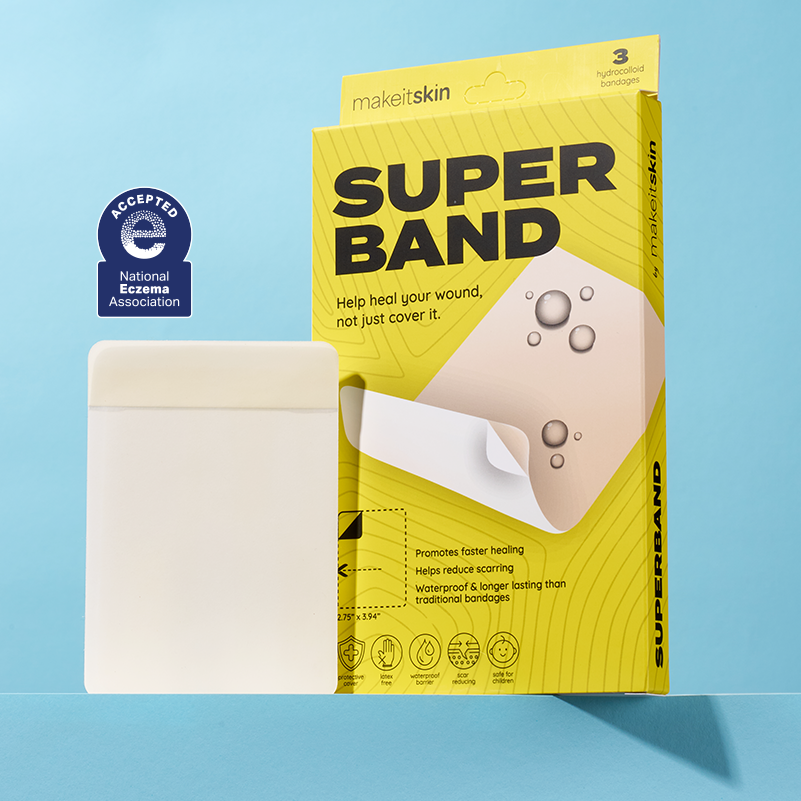
1. Hydrocolloid sheet, trimmed to fit. This is the only format where you control the outline. SUPERBAND Cut-To-Size is our version, a flat hydrocolloid sheet you cut to the burn's shape, listed at $20; we sell Precision Carabiner Shears at $10 for the trimming. The honest caveat is that this option asks something of you: you have to cut it, and cut it well, on skin that is properly dry. A rushed, jagged cut reintroduces exactly the seal flaws the patent describes.
2. Pre-cut hydrocolloid patch. BAND-AID Hydro Seal and Nexcare's waterproof range both sell hydrocolloid in fixed shapes. On the back of a hand or a forearm they seal fine. On a knuckle the fixed outline has to bridge a curve, and the corners are where soapy water gets a foothold. Our own SUPERBAND On-The-Go pre-cut packs, listed at $15, share that same geometric limitation. They are the portable option, not the custom-fit one.
3. Transparent film dressing. Thin, conformable, waterproof. Films offer little absorbency, so a burn that is still weeping can pool underneath.
4. Fabric strip bandage or gauze. Neither is waterproof, and gauze can dry onto a burn surface. Save them for a dry, covered wound that is not going near a sink.
SUPERBAND Cut-To-Size
20.00 USD
Shop now
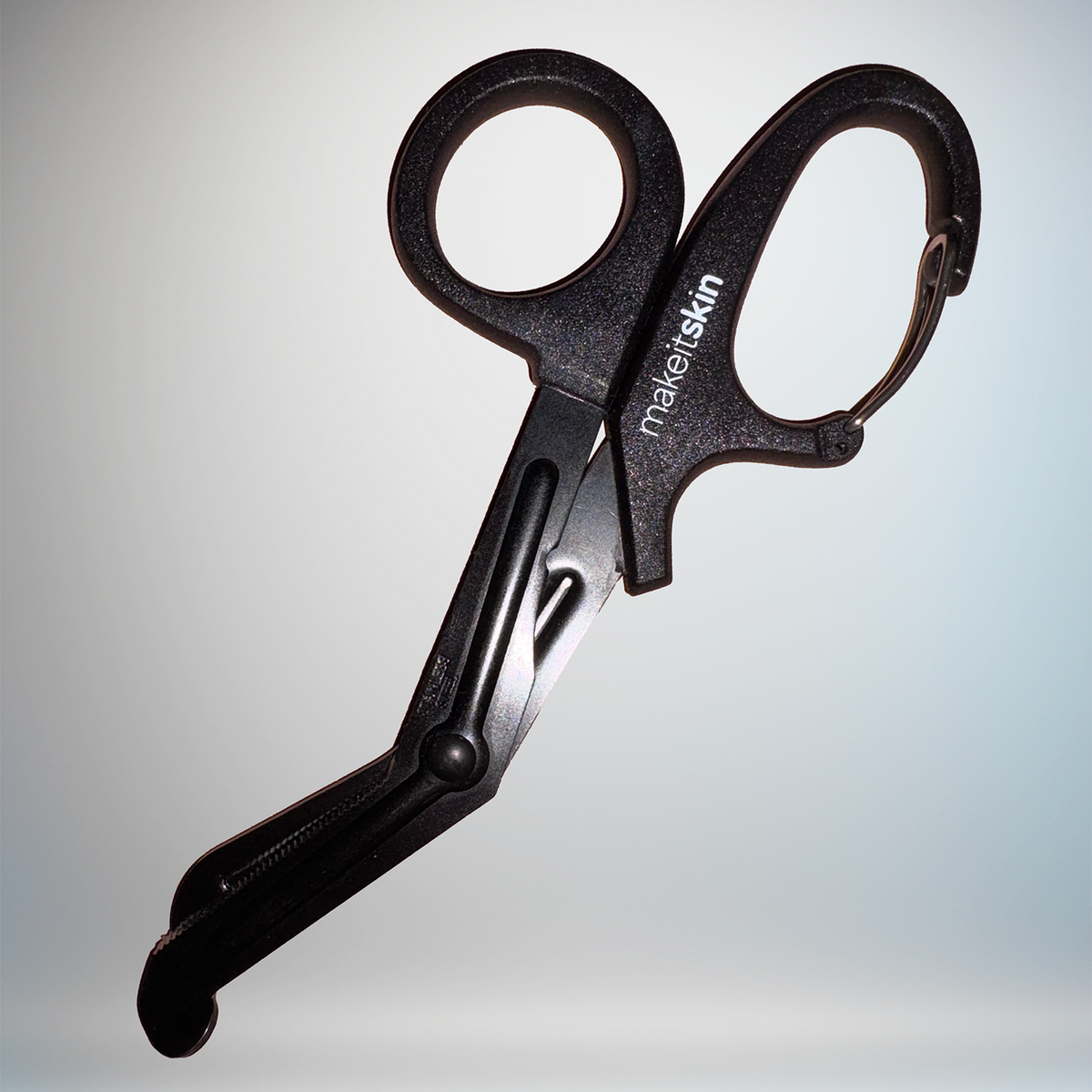
Precision Carabiner Shears
10.00 USD
Shop now
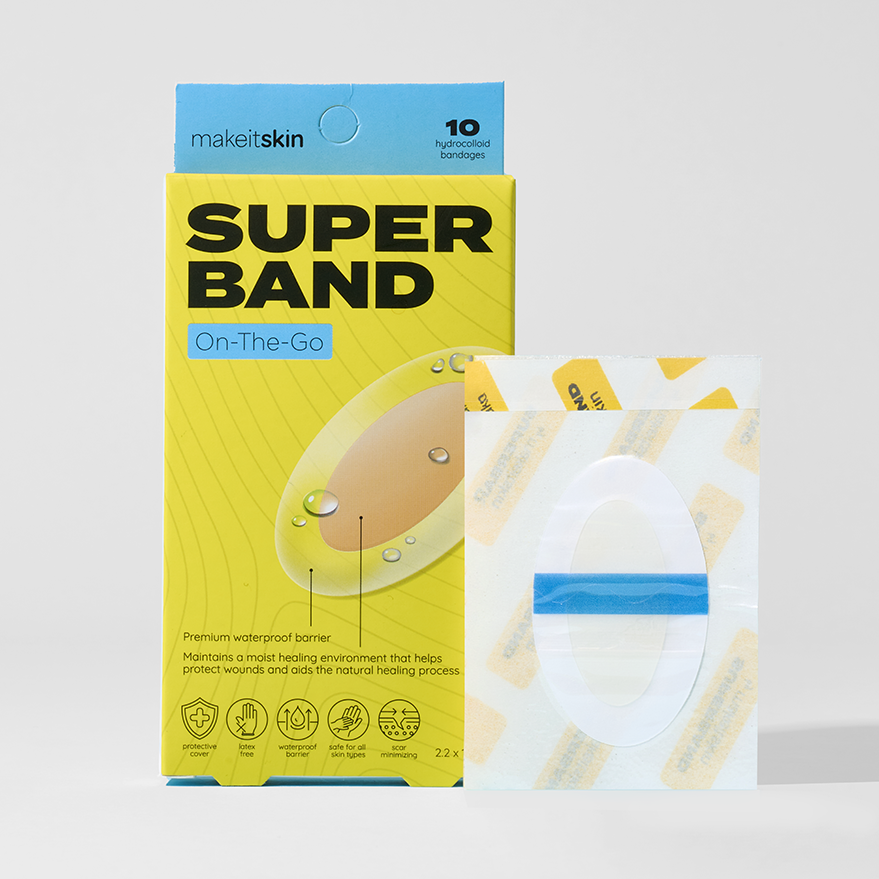
SUPERBAND On-The-Go
15.00 USD
Shop now
Trimming the sheet so there is no corner to lift
Five minutes of care here buys you the rest of the evening.
- Measure a margin around the burn. Cut a shape that extends roughly a centimetre past the burn edge on all sides, so adhesive lands on intact skin all the way around.
- Round every corner. A square corner catches on a sponge or a pan handle and starts to peel back. A rounded outline gives soapy water no sharp edge to enter.
- Follow the anatomy. For a fingertip, cut a rounded shape and split one side into two short tabs so they wrap the curve without creasing. For the thumb web, cut a narrow hourglass so the dressing flexes with the joint instead of bunching.
- Apply to dry skin, centre first. Press from the middle outward, then hold the whole dressing under your palm for about 30 seconds. Warmth helps the adhesive bond.
- Check the rim before you turn on the tap. Run a fingertip around the edge. Anything that lifts should be smoothed down or the piece recut.
After dishes, pat the dressing dry rather than rubbing it, and leave it alone. Repeated prodding at the edge does more damage than the water did.
When to change it and when to call someone
Change the dressing if it lifts at the edge, if fluid has worked its way out from under it, or if the burn becomes more red, swollen, or painful than the day before. A hydrocolloid also turns whitish and puffy as it absorbs fluid, which is normal gel formation rather than infection, though a dressing that is saturated to the edges should be replaced.
Not every kitchen burn belongs in a home first aid routine. Mayo Clinic notes that even a minor burn may need medical attention when it affects the eyes, mouth, hands or genitals. If a burn blisters widely, if you cannot tell whether it is second or third degree, or if it is not starting to improve within a few days, have a clinician look at it before you keep self-treating.
FAQ
Can I wash dishes right after applying a hydrocolloid dressing?
Give the adhesive a few minutes of skin contact and body heat first, and check that no edge is standing off. The bond improves with warmth and pressure, so applying it and immediately plunging your hand into hot soapy water is the least favourable start you can give it.
Does wearing rubber gloves solve the problem instead?
Gloves keep bulk water off, and they help. Hands sweat inside them, and the patent filing behind US 11,793,680 notes that sweat forming under a protective waterproof covering can affect the dressing underneath much the same way a leak does. A dressing that seals properly on its own is still the base layer.
Why does my bandage survive a shower but fail at the sink?
Shower water is largely plain water with brief soap contact. Dishwashing means sustained contact with concentrated detergent at warm temperature while the hand flexes, which is the surfactant scenario the patent background describes.
Should I put ointment under the dressing?
Follow the directions on whatever product you are using, and check your dressing's label before combining the two. Cleveland Clinic's first aid guidance for burns advises against ointments and sprays at the initial cooling and covering stage.
What size should I cut for a burn on a fingertip?
Cut wider than you think. A fingertip has curvature in two directions, so you need enough surrounding adhesive contact to hold the piece down, plus tabs or a rounded outline so the material does not crease as the finger bends.
For more on the dressing choice itself, we have written about which bandages actually stay on in the shower, choosing hydrocolloid bandages for minor burns at home, and gentle burn dressings for sensitive skin.
If you cook often and want the version you can shape to a knuckle, keep a SUPERBAND Cut-To-Size sheet and a pair of shears in the kitchen drawer.


