

Gentle Patches for Kids Who Scratch Mosquito Bites
Gentle patches do help, mostly by covering the bite so fingernails cannot reach it and by absorbing the fluid underneath. The choice that matters is the stage of the bite: an intact itchy bump and a bite that has already been scratched open need different products, and several popular bite patches say on their own labels not to use them on broken skin. Nothing you stick on the surface removes histamine from a child's bloodstream, so the honest goal is interrupting the scratching before the skin breaks.
We make SUPERBAND hydrocolloid bandages, including a bite patch, so treat this as a maker explaining the category rather than a neutral survey. The evidence below comes from children's hospitals, dermatologists quoted in the press, and published research on the ingredients involved. Where a competing product's own label contradicts its marketing, we say so and link to the page.
Why the scratching does more damage than the bite
A mosquito bite on its own is a short-lived immune reaction. The problem in a household with kids is what happens over the following three days.
Seattle Children's Hospital notes that infections of mosquito bites are uncommon and that when they do occur, they most often appear in bites children have scratched or picked at, usually starting with an infected sore or scab. St. Louis Children's Hospital describes the same path toward impetigo, a local bacterial infection with sores and soft scabs, and its advice for a bite that has already been picked open is blunt: cover the scab with a bandage to help prevent scratching and spread.
That is the whole case for patches in one sentence. A cover is the one intervention that works while a four-year-old is asleep and scratching without knowing it.
Timelines help set expectations too. St. Louis Children's puts the typical itch at three or four days, with swelling that can last about a week and dramatic puffiness around the eye when the bite lands on the upper face. Parents often reach for a patch on day two, when the bite is still itchy and the skin around it is starting to look raw.
What a patch can honestly claim
Dermatologists quoted on this category agree on the mechanism and disagree on how much itch relief to promise.
Dr. Anna Chacon, a board-certified dermatologist in Miami, told NBC Select that “Most bug bite patches work by absorbing the fluid in the area”, which helps with itching and protects the skin from further irritation. In the same piece, dermatologist Dr. Hannah Kopelman described patches as no miracle cure while crediting them with reducing itching, protecting skin, and helping prevent infection from constant scratching.
Dr. Megha Trivedi, a dermatologist at RUSH University Medical Center, gave NBC Chicago a useful corrective: she said a hydrocolloid patch is a reasonable choice for a mosquito bump, then added that “Some of these claims that hydrocolloid patches help with itching are actually not true”.
Both things hold. Hydrocolloid is a wound-care material with a long clinical history. Its job is absorption and a sealed, moist environment, and the itch relief a parent observes is largely downstream of coverage and fluid management rather than a pharmacological block on histamine. If a child needs the itch itself treated, that is a conversation with your pediatrician about a cold compress, an antihistamine, or a 1% hydrocortisone cream, all of which children's hospitals list as standard care.
Intact bump or broken skin: check before you choose
Spend ten seconds on this before you open a box, because it decides which products are even eligible.
Still intact. A raised pink or red bump, firm to the touch, no weeping, no scab. The surface is unbroken. Every patch type on the market is usable here.
Already open. Scratch marks, a scab, a shallow crater, any clear or yellowish fluid. This is a wound now, and grid-style film patches specifically exclude it. Moskinto's own product page carries the instruction “Do not stick to open wounds!” alongside its description of a grid-shaped polyester and polyurethane patch containing no active ingredients.
Needs a clinician, not a patch. Spreading redness that is painful to the touch, a red line running up the limb, pus, fever, or swelling that extends well beyond the bite. St. Louis Children's lists cellulitis and lymphangitis among the complications that follow scratched bites, and those need medical care rather than a sticker.
Four kinds of bite patch, and what each label actually says
| Patch type | Stated mechanism | Label limits worth knowing | Suits |
|---|---|---|---|
| Grid-shaped film (Moskinto) | Grid shape said to help the lymphatic system drain mosquito saliva and anticoagulants | Product page says not for open wounds, and states the effect “has not been scientifically proven”, with claims based on experience and case studies | Intact bumps only |
| Plain hydrocolloid (Cutter, many private labels) | Absorbs fluid from the bite and blocks nails | No active ingredient; some patches are simply hydrocolloid and intended to stop you scratching | Intact or lightly scratched |
| Hydrocolloid plus soothing botanicals (Sarna, Welly, Buzzluv) | Hydrocolloid barrier carrying aloe, witch hazel, arnica or chamomile | Crown Laboratories describes Sarna's patches as preventing picking and scratching while botanicals soothe; botanical content varies by brand | Intact or lightly scratched |
| Medical-grade hydrocolloid plus centella asiatica (our SUPERBAND Bug Bite Relief) | Wound-grade absorbency plus a botanical studied for itch and skin inflammation | Centella research covers the ingredient, not this finished product; individual skin tolerance still varies | Bites a child has already scratched open |
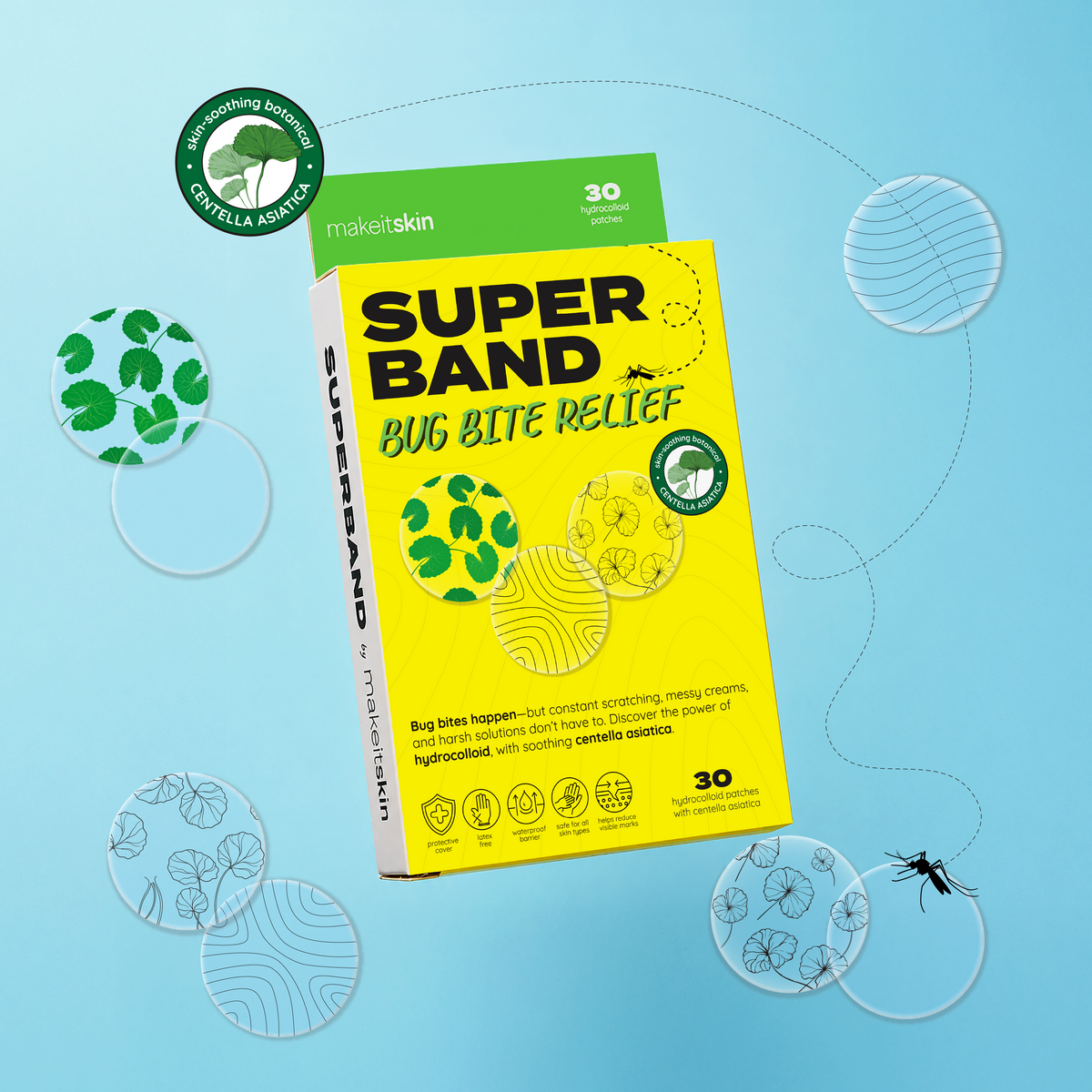
A film patch on an unbroken bump and a wound-grade dressing on a scratched sore are aimed at different moments in the same week, which is why many households end up with two boxes in the cupboard.
Where centella asiatica fits, and how far the evidence goes
Centella asiatica, also called gotu kola, is the ingredient we chose for the bite patch, and it is the one botanical in this category with published work aimed squarely at itch and skin inflammation.
Mathew George, Lincy Joseph and colleagues, writing in the African Journal of Traditional, Complementary and Alternative Medicines in 2009, tested centella extracts against itch and inflammation in rats and against allergic response in vitro, and reported that the extracts showed antiallergic, anti-pruritic and anti-inflammatory activity. The anti-pruritic arm used oral dosing in animals, which is worth knowing before anyone reads it as proof about a patch.
Closer to the skin, a 2020 study in PubMed Central found that centella ethanol extract inhibited IL-6 and TNF-alpha expression in a dose-dependent manner in inflammation-stimulated human skin cells, with reduced mast cell infiltration in the animal model alongside it. A 2023 review of centella and its metabolite asiatic acid describes activity across the inflammatory, proliferative and remodeling phases of cutaneous wound healing, including reduced pro-inflammatory cytokines and increased collagen synthesis.
What that evidence supports is a rationale for pairing a wound-grade dressing with centella when the skin is broken. It is not a clinical trial of our patch, and we will not present it as one. No published study compares SUPERBAND Bug Bite Relief against another brand's patch on children's mosquito bites.
Our patches, described plainly
SUPERBAND Bug Bite Relief pairs medical-grade hydrocolloid with centella asiatica and costs $16. We built it for the stage most bite patches step around: the bite a child has already worked open. The hydrocolloid handles wound fluid and seals the site, and the centella is there for the local inflammation that both the bite and the scratching produce.
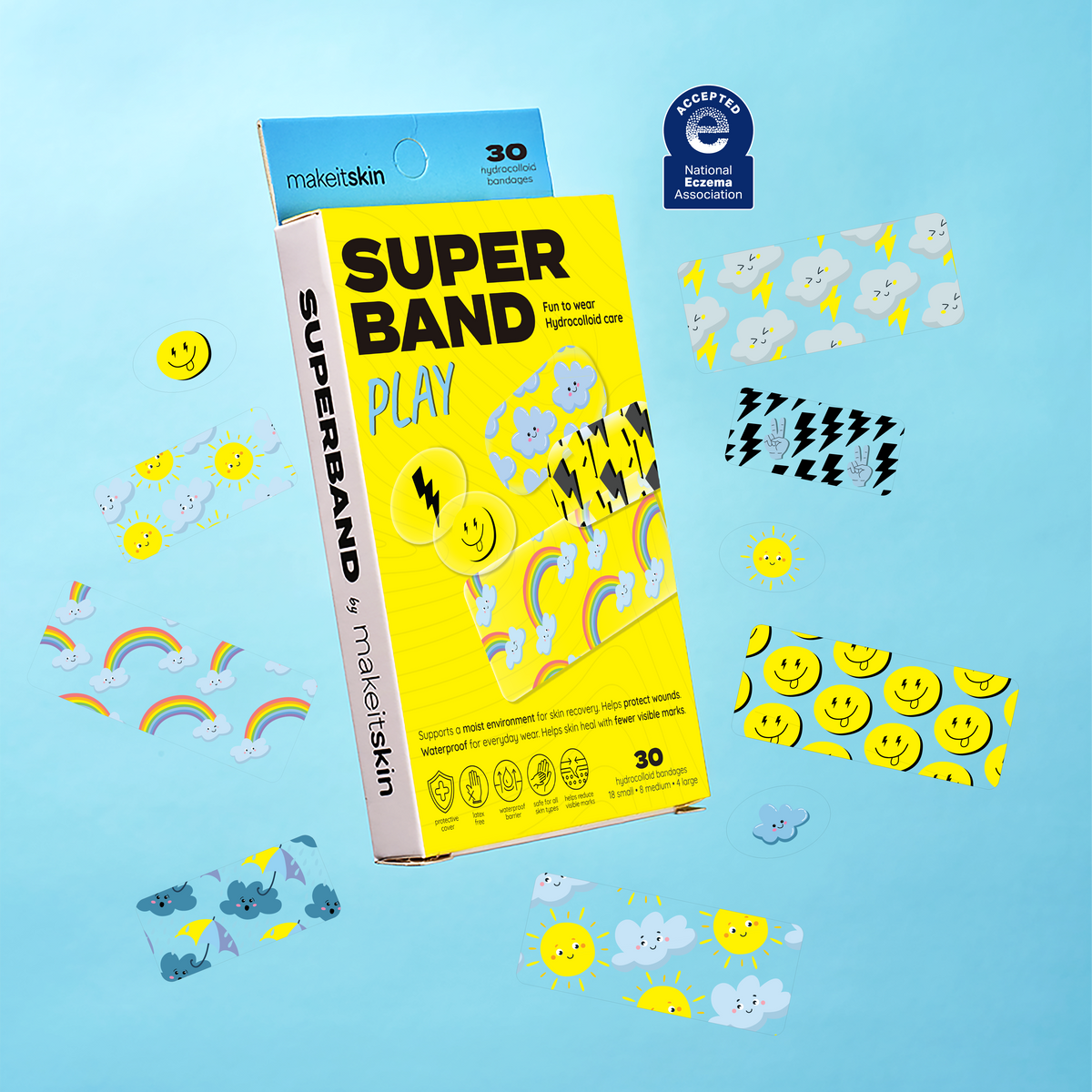
For a kid who pulls off anything medical-looking, SUPERBAND Play ($18) is the same hydrocolloid construction in designs children choose to keep on. Cooperation is a real clinical variable with children, and a patch that gets peeled off at recess does nothing.
SUPERBAND Bug Bite Relief
16.00 USD
Shop now
SUPERBAND Play
18.00 USD
Shop now
Two honest limits. Our patches are not medicated, so they do not contain an antihistamine or hydrocortisone and will not switch off an itch the way a medicated cream can. And while hydrocolloid adhesives are generally well tolerated, individual skin tolerance varies, so watch the border of the patch on a child with reactive skin and stop if the surrounding skin becomes irritated.
Getting a patch to stay on a child
- Wash first. Warm water and mild soap over the bite, then pat dry. Children's hospitals put cleaning ahead of everything else, since scratched bites get infected by way of dirty fingernails.
- Dry properly. Hydrocolloid needs a dry perimeter to seal. Damp skin is the most common reason a patch lifts within the hour.
- Apply without stretching. Press from the centre outward. Warm the edges with a fingertip for a few seconds.
- Trim the nails at the same time. A patch plus short nails beats either one alone.
- Leave it. Expect the patch to whiten as it absorbs fluid. That is the material working, not an infection.
- Change it when the white area reaches the edge, when it starts lifting, or per the product directions.
Bath and pool time are usually fine with a waterproof patch. If it peels after swimming, dry the skin fully and apply a fresh one.
When to stop patching and call the pediatrician
Call if the redness spreads outward and is painful to touch, if a red line runs up the arm or leg, if there is pus or fever, or if the bite has not started improving after several days. St. Louis Children's flags cellulitis, impetigo and lymphangitis as the infections that follow scratched bites. Severe allergic reactions, swelling of the face or lips, or breathing trouble are emergencies, and no patch of any brand is appropriate for them.
FAQ
Are bug bite patches safe for toddlers?
Hydrocolloid patches are widely sold for children and are drug-free, which is the main reason parents choose them over medicated creams for young kids. Watch for a choking risk with small round patches on very young children, keep the packet out of reach, and ask your pediatrician about anything on an infant's face.
Will a patch actually stop the itch, or just hide the bite?
Expect partial relief through coverage and fluid absorption rather than an itch switch. Dr. Megha Trivedi of RUSH University Medical Center has pushed back on itch-relief claims for hydrocolloid specifically, and we think that is the right expectation to set.
Can I put a patch over hydrocortisone cream?
Do not layer a cream under an occlusive dressing unless the cream's label or your pediatrician says to. Sealing a medicated product against skin changes how much of it is absorbed. Use one or the other, and space them out.
Is a pimple patch the same thing?
Both use the same material family. Pimple patches are thin cosmetic-grade hydrocolloid sized for the small fluid volume of a blemish, while a bite that has been scratched for days produces more fluid and needs a thicker dressing with proper wear time.
How long can one patch stay on?
Follow the directions on the pack. As a general rule for hydrocolloid, change it when the whitened gel area reaches the edge of the patch or when the seal starts to lift. A bite producing a lot of fluid will saturate a patch sooner than a nearly healed one.
Keep reading
If you want the full comparison across the category, we wrote Best Bug Bite Relief Patches 2026: Patch vs Cream. For how the material behaves across cuts, scrapes and blisters, see Best Hydrocolloid Bandages: How to Choose (2026).
If the bite in your house is already scratched open, that is the case [SUPERBAND Bug Bite Relief](https://makeitskin.com/products/superband-bug-bite-relief) was built for.


